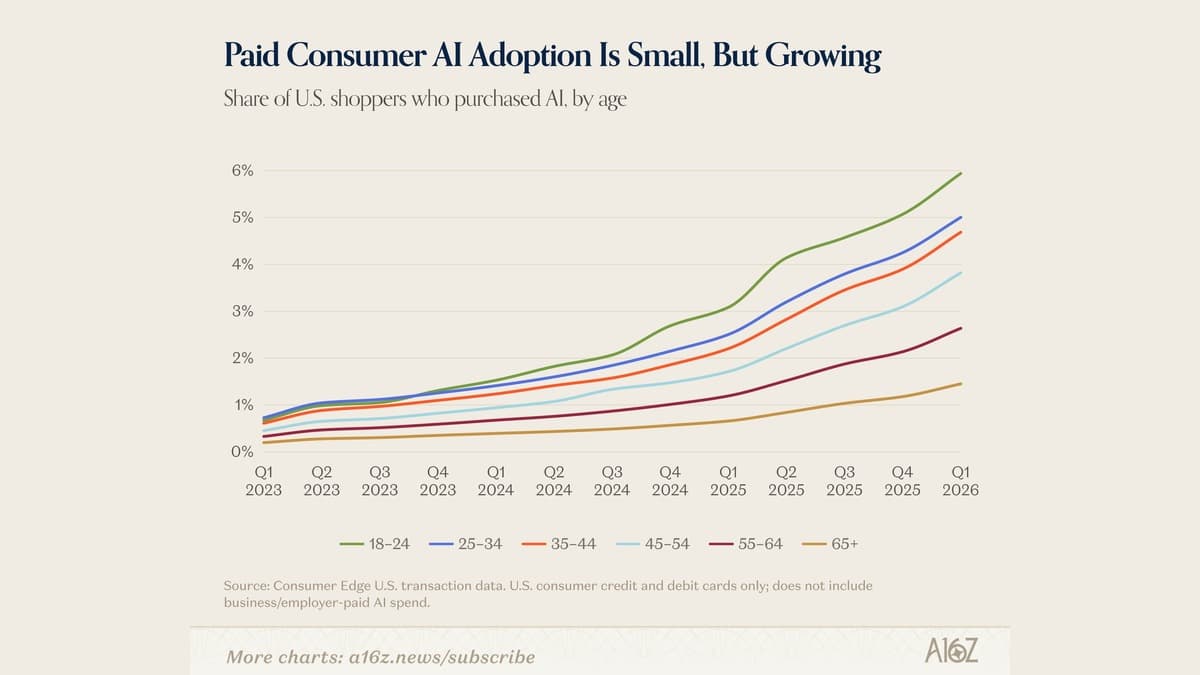
AI coding tools have made building apps several times faster. But time spent and revenue in the app market are moving only modestly, and only about 3 in 100 US consumers pay for an AI service with a personal card. a16z's chart commentary, published September 18, 2026 (September 19 in Korea), shows the gap between the surge in app supply and willingness to pay.
a16z calls this trend "App-Slop." It describes a flood of apps built with AI tools, without a matching rise in apps people actually use.
The key line from the original: "AI apps are plainly very popular, but the apps made by AI, not so much." In other words, AI apps themselves are clearly popular, but growth signals for apps made with AI are much more modest.
App supply has grown several times over
According to NBER Working Paper 35275, which a16z cites, monthly new app counts on iOS, Android, and the Chrome Web Store grew to about 2 to 4 times their earlier levels after coding agents spread. Over the same period, downloads and iOS ratings across apps stayed roughly flat. From January 2025 to April 2026, the share of apps that failed to reach an early-user benchmark in their first three months after launch rose from 78% to 87% on iOS, from 22% to 26% on Android, and from 19% to 33% on Chrome.
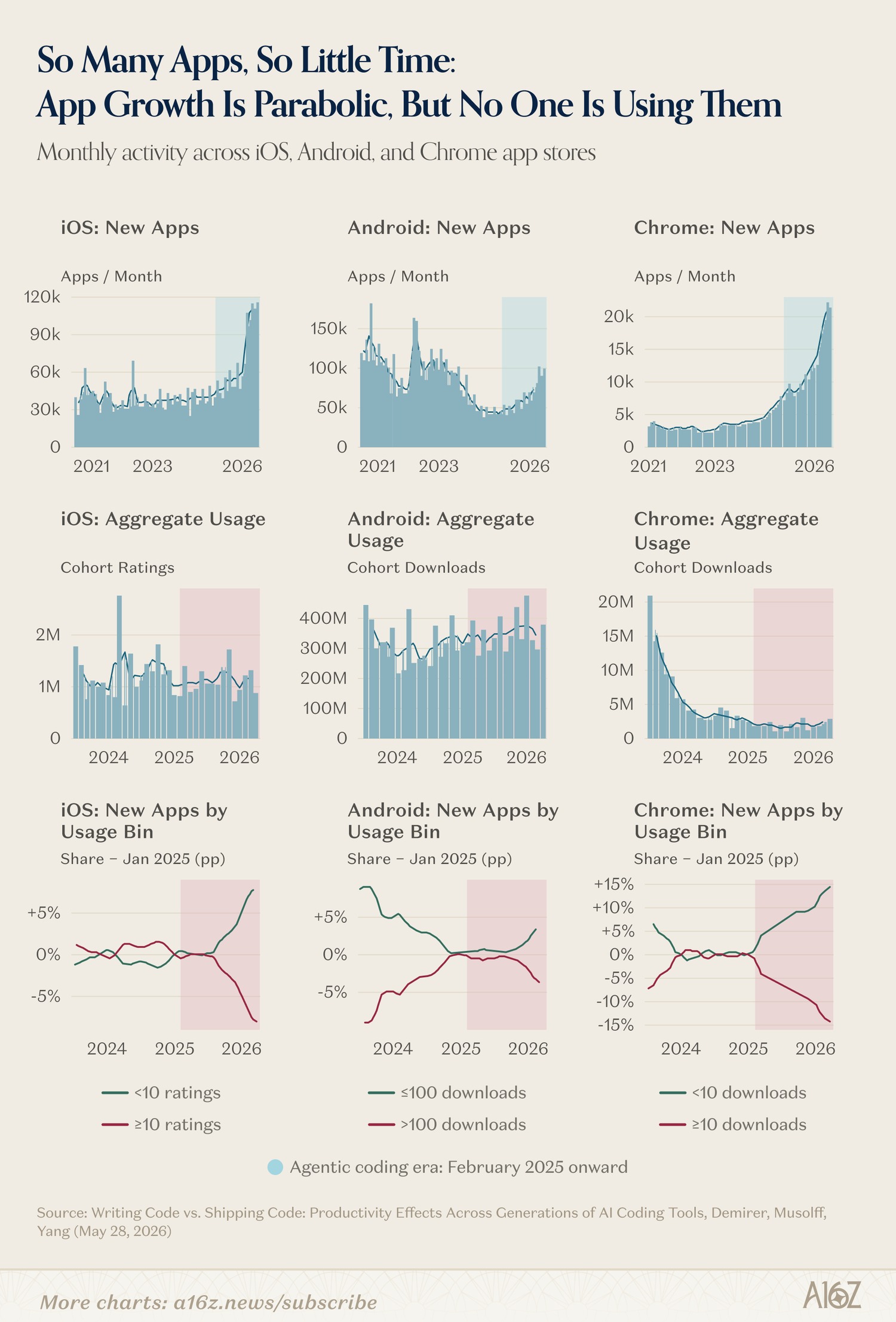
The paper is "Writing Code vs. Shipping Code: Productivity Effects Across Generations of AI Coding Tools" by Mert Demirer, Leon Musolff, and Liyuan Yang. It is an NBER study released in May 2026, and a September revision is reflected here. Analyzing the activity of more than 500,000 developers on GitHub, it found that coding activity rose 30% with autocomplete, 180% with conversational agents, and 240% with autonomous agents across tool generations. Project counts rose 80% and actual releases rose 30%, so the further you move from writing code toward shipping a product, the more separate execution ability matters.
Take a look at the a16z post that introduced the growth in app supply. X @a16z shared a chart showing new iOS apps up 60% year over year in December 2025.
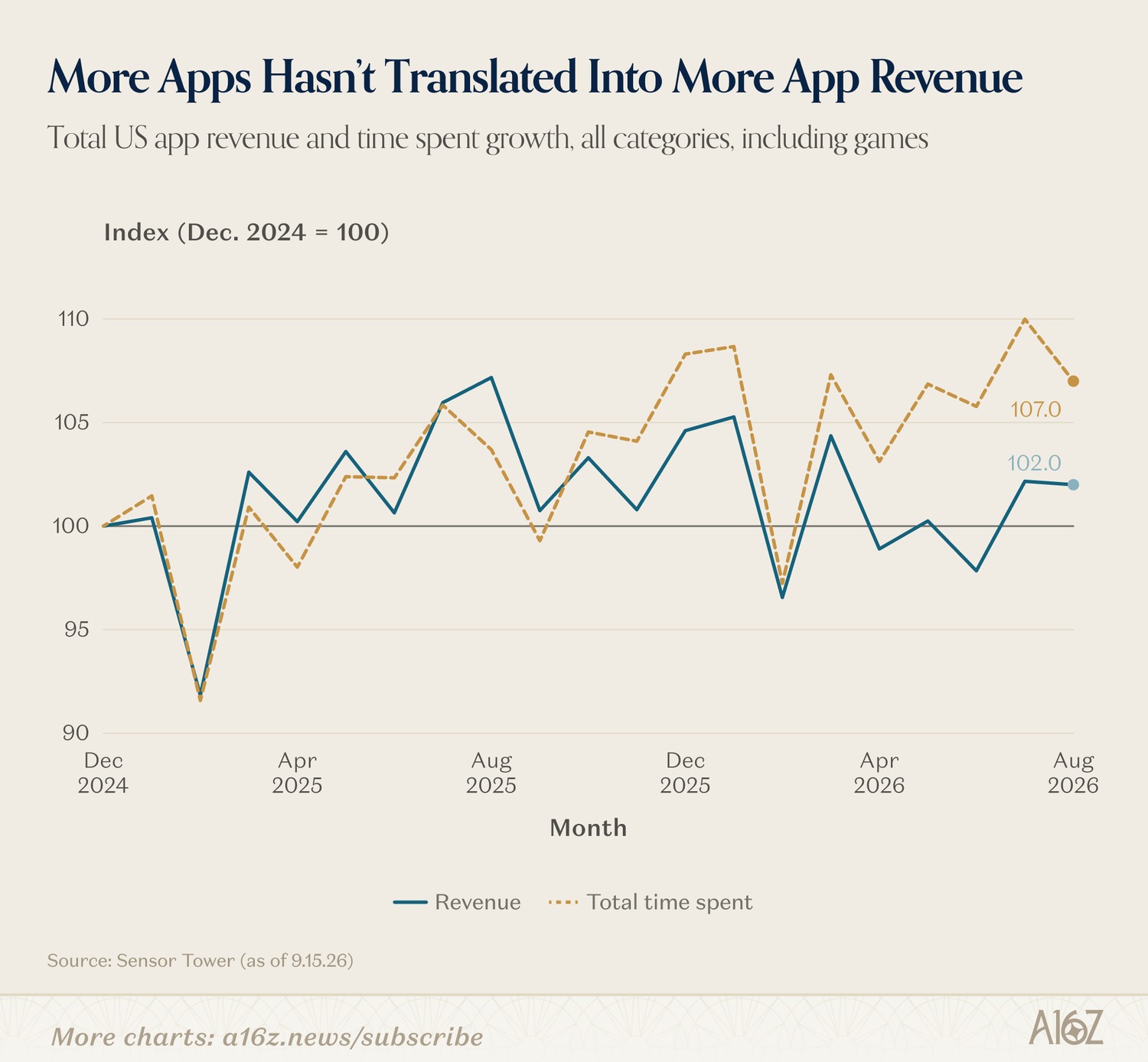
Total app market revenue is up 2% and time spent is up 7%
In US app market metrics compiled by Sensor Tower as of September 15, 2026, total revenue rose about 2% and time spent rose about 7% over the past year and a half. This is less a market where app usage jumped several times over at once than one where growth drivers differ by category.
Productivity apps and AI tools drove usage
Productivity was the category where time spent grew fastest. By revenue growth it ranked second, behind Food & Drink. ChatGPT, Claude, Gemini, and Grok led this trend, and in the Dev Tools category, Replit led growth.
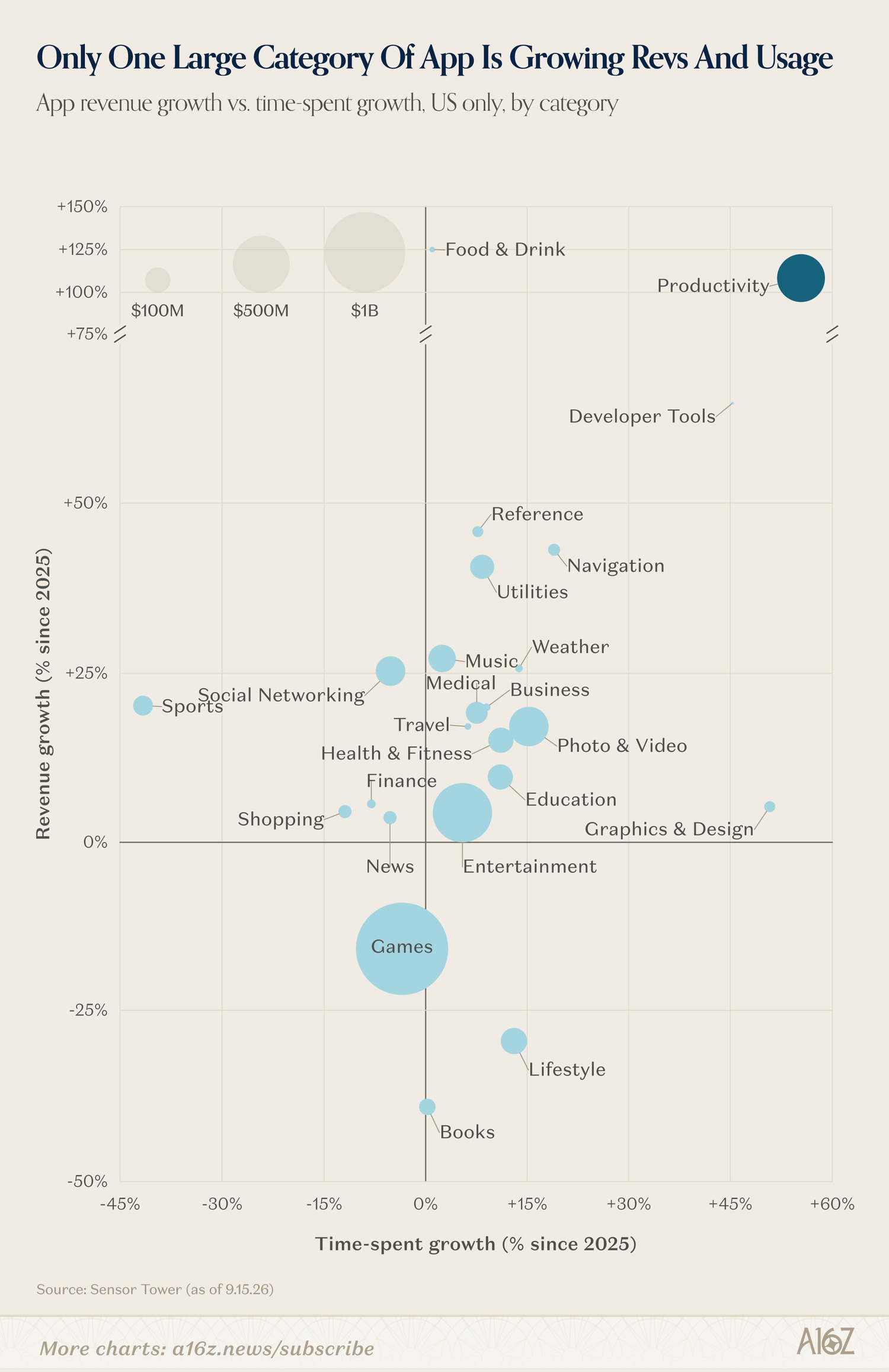
So "AI apps are popular" and "apps made with AI tools get chosen" are different questions. Consumers are spending more time on productivity tools like ChatGPT, and for a new app to win that much attention and revenue in the overall market, it needs a specific reason to be used.
About 3 in 100 US consumers pay for AI
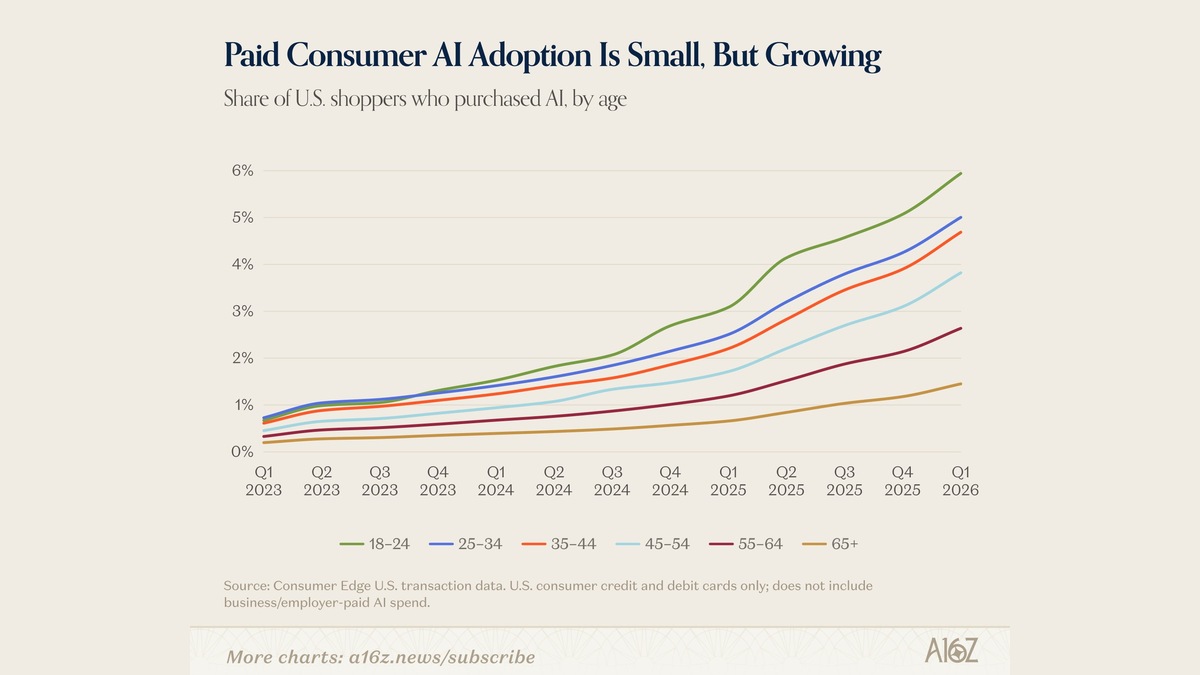
In Consumer Edge's analysis of US consumer card transactions, paid AI subscription penetration rose from under 1% in 2023 to about 3% in Q1 2026. The figure reflects the share of paid transactions seen on personal credit and debit cards. It does not include free users or payments covered by a company or employer.
By age, penetration was about 6% for ages 18 to 24 and about 1.5% for ages 65 and up, so the youngest buyers paid at roughly four times the rate. Differences in adoption by generation are a clue to which product experiences give new customers immediate value.
The hard part is not code but a problem painful enough to pay for
Using AI and paying for AI are completely different matters. About 3 of every 100 US consumers pay for AI services with a personal card, and the other 97 use it for free or have not started yet.
The 18-to-24 group may have opened their wallets first because they hit the "I can't do without this" moment sooner than other age groups. Payment is a signal that a product clearly reduces a real pain in daily life.
For people building apps, the hard part now is not writing code but finding a problem painful enough that people will pay. The ability to build apps faster is widespread, and your next choice depends on which problem you decide to solve.
Look at what problems the 3% who already pay are paying for, and you can see where the next 3% will come from. What that 3% buys will shape the next year.
Sources
- a16z, Charts of the Week: So Many Apps, So Little Time · Moses Sternstein, September 18, 2026 (September 19 in Korea)
- NBER Working Paper 35275, Writing Code vs. Shipping Code · Paper PDF
- Consumer Edge, AI Goes Mainstream as Adoption Doubles
- Sensor Tower market data cited by a16z, as of September 15, 2026