A usable real-time interpreter AI has arrived. But how it was released changes the story. Alibaba's Qwen offered Qwen3.8-LiveTranslate through an API, and two days later released the weights of its image generation and editing model, Qwen-Image-2.1. Put the two choices side by side and one question remains: open for whom, when Qwen says "open"?
Real-time interpretation you'd want for travel and meetings
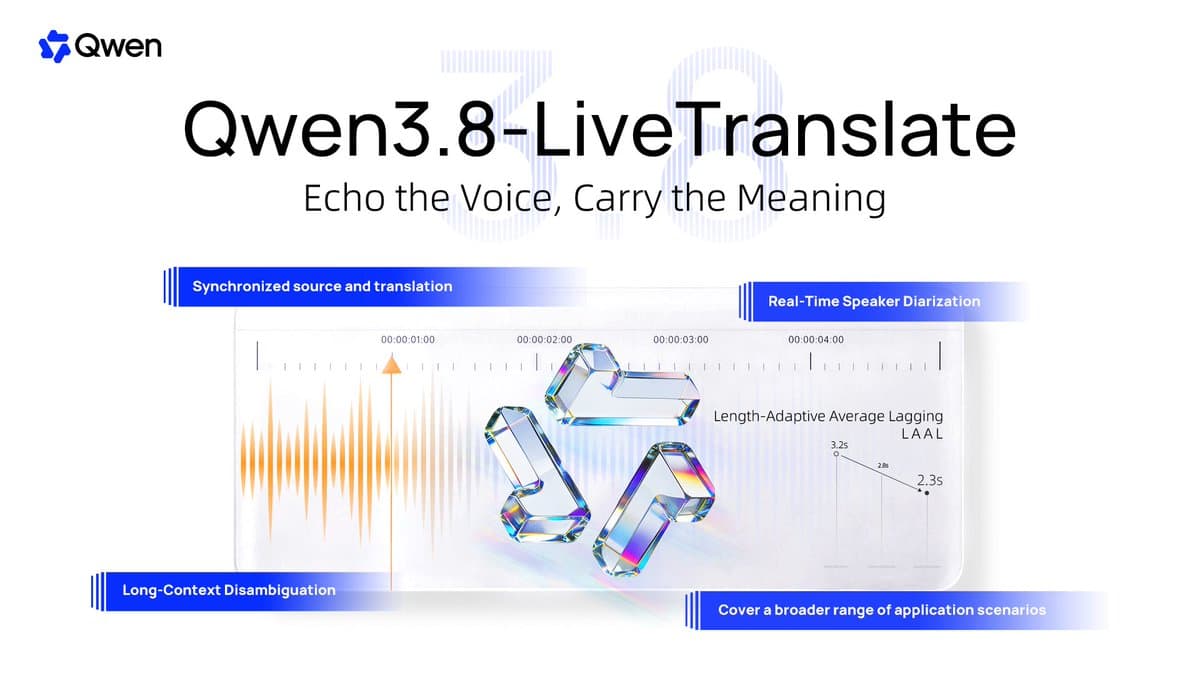
Announced on September 18, 2026, Qwen3.8-LiveTranslate is a real-time simultaneous interpretation model that listens to speech and outputs translated speech. According to the official description, it supports speech recognition and text translation in 60 languages and speech output in 29 languages. It distinguishes among multiple speakers, carries over people's names and proper nouns using earlier conversation context, and generates speech that preserves the original speaker's voice characteristics.
Qwen announced that LAAL, an average latency metric, dropped from 2.8 seconds to 2.3 seconds. That doesn't mean response time in every situation is 2.3 seconds, but it's clear this is a product meant to keep interpreting as the conversation goes back and forth. It's technology you'd want to try yourself when talking with locals while traveling or running a multilingual meeting.
Source: X @Alibaba_Qwen
But the weights weren't opened
LiveTranslate is not an open-weights model you can download and run yourself. The official way to use it is Alibaba Cloud's DashScope real-time API. The model ID is qwen3.8-livetranslate-flash-realtime, and speech is exchanged over WebSocket. The official example for the Beijing region uses the address below and requires an API key and a workspace ID.
wss://{workspace_id}.cn-beijing.maas.aliyuncs.com/api-ws/v1/realtime?model=qwen3.8-livetranslate-flash-realtimeBilling is also tied to usage. On the official price list for the Beijing region, input speech is 40 yuan per million tokens, output text is 100 yuan, and output speech is 160 yuan. The input image rate is listed as 3.3 yuan per million tokens. Rates can vary by region and modality, so check the official DashScope price list before making real calls.
This approach makes it easy to add interpretation to an app or service. On the other hand, users have to accept an API account, connection, and token costs, and they can't download the model itself to run it locally or deploy it in a separate environment. Given how Qwen has released the weights of many models, including Qwen2.5, Qwen3, and Qwen-Image, LiveTranslate's choice stands out all the more.
Two days later, the image model's weights were released
On September 20, two days after the LiveTranslate announcement, Qwen released Qwen-Image-2.1. It's a model that combines image generation and editing, and you can download the weights and run it locally. It can generate images with transparent backgrounds, use multiple reference images, and edit specified regions, and it can also be used to composite or edit people's faces. A general-purpose capability like this creates a risk of being abused for deepfakes. Once the weights are released and copies spread, Alibaba can't recall them remotely.
Source: X @Alibaba_Qwen
Source: X @Alibaba_Qwen
That the weights are released doesn't mean there are no license restrictions. Qwen-Image-2.1's Qwen Research License limits use to noncommercial research and evaluation and requires separate permission for commercial use. Still, if you download the weights and run them locally, you can work without going through Alibaba's inference servers every time.
This difference ties into Qwen's open-weights activity. It has steadily released models that developers and researchers can work with directly, such as Qwen2.5, Qwen3, and the predecessor Qwen-Image. The release method differs by model, and even when weights are released, you need to check the license terms separately.
Why do the release criteria look opposite?
If open weights were the criterion, the interpreter model should have been opened too. If safety were the criterion, given the risk of deepfake abuse and the fact that weights can't be recalled once released, it would be natural to release the higher-risk image model cautiously first. The actual choice is exactly the reverse.
In reality, the interpreter model you'd want to use in daily life sits inside a service API, while a model that can even edit images of people can be downloaded and run directly. The same company has opened doors in opposite directions for the two models.
Seen as a business, it's easier to explain
Alibaba hasn't explained the reasons for either choice. Even so, judging by the results alone, the image weights were released to grow the developer ecosystem, while real-time interpretation was kept inside an API where token usage turns into revenue. The risk is shared by society, and the revenue from the useful service goes to the company.
Open for whom?
It releases the image model that's good for growing an ecosystem and holds on to the interpreter model that's good for collecting ongoing payments. This isn't to say open weights are bad. The issue is what was opened and what was closed, and who gets the risk and the benefit of that choice.
For an Alibaba that closed its interpreter AI and opened its image AI, open for whom?