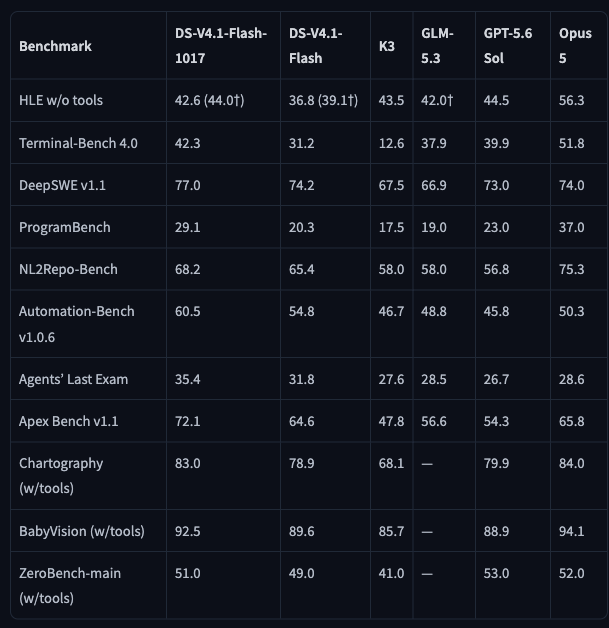
DeepSeek V4.1-Flash-1017 was released on October 17, 2026, and scored 77.0% on the coding agent evaluation DeepSWE in DeepSeek’s own testing. That is higher than the 74.0% reported for Claude Opus 5 in the same materials, but the model scored lower than Opus 5 on advanced reasoning and terminal tasks. Considering its cost of about $0.2 per task and its release terms can help determine which development tasks it may suit.
What changed in DeepSeek V4.1-Flash-1017
This model is an updated version of DeepSeek V4.1-Flash. According to the provided materials, it focuses on reducing output length and task costs while keeping the existing API prices. So the point of interest is not only whether scores improved, but also how output and costs change when handling the same task.
DeepSeek released the model weights, and the official Hugging Face repository lists the MIT license. The repository also provides a Transformers loading example and instructions for using vLLM.
The Safetensors metadata in the Hugging Face repository lists the total file size as 510,304,178,606 bytes. If you plan to download and run the model yourself, first consider the model file size and your execution environment.
What does a 77.0% DeepSWE score mean for coding tasks?
The comparison figures in the provided materials are as follows. Both scores are results of DeepSeek’s own testing.
| Model | DeepSWE score |
|---|---|
| DeepSeek V4.1-Flash-1017 | 77.0% |
| Claude Opus 5 | 74.0% |
The difference between 77.0% and 74.0% cannot be directly interpreted as a difference in real-world development productivity. Benchmark scores reflect results under specific test conditions, and practical outcomes can vary with a team’s code structure, dependencies, and testing methods. In particular, the materials state that these figures come from DeepSeek’s own testing, not an independent organization, so they are best treated as a reference metric.
Teams with frequent code changes or tests can compare issue resolution rates, test pass rates, and the number of changes required for a task in their own repositories. What matters more than a single score is whether results are reliable for the tasks you actually plan to assign.
How does a cost of about $0.2 per task differ from API pricing?
The provided materials give a cost of about $0.2 per task. This is not measured on the same basis as the API token price. Token pricing calculates costs based on input and output usage, while cost per task refers to the cost of completing one task.
Rather than comparing the two figures directly, it is useful to track input length, output length, and the number of retries for the same task. DeepSeek says it reduced output length and task costs while keeping existing API prices, but actual charges can vary with input and output usage, the number of retries, and the workflow.
Can you expect the same performance on reasoning and terminal tasks?
A higher score on a coding evaluation does not mean the model is better at every type of development task. According to DeepSeek’s own measurements in the provided materials, its scores on advanced reasoning and terminal tasks were lower than those of Claude Opus 5. Resolving coding issues, handling complex reasoning, and chaining multiple terminal commands can require different capabilities.
If you plan to use the model for terminal automation or difficult reasoning, test it separately. Also check the impact of executing an incorrect command and the recovery process after a failure. It is safer to base adoption decisions on success rates and retry costs in real tasks rather than benchmark rankings.
What should you compare before adopting an MIT-licensed open model?
What you need to prepare depends on whether you plan to run the model yourself or use it through an API. If you are considering self-hosting, first check the model file size, storage space, and inference environment. If you plan to use the API, calculate token usage and cost per task separately. The official repository lists the MIT license, but it is best to check the repository’s license document directly for terms relevant to your intended use.
The official repository provides instructions for using Transformers and vLLM. However, the presence of these instructions does not guarantee that the model will run smoothly on your available hardware. Start with small tasks to check quality and workflow, and compare the results for coding tasks and reasoning or terminal tasks separately.
Official source used: Hugging Face DeepSeek V4.1-Flash-1017 repository