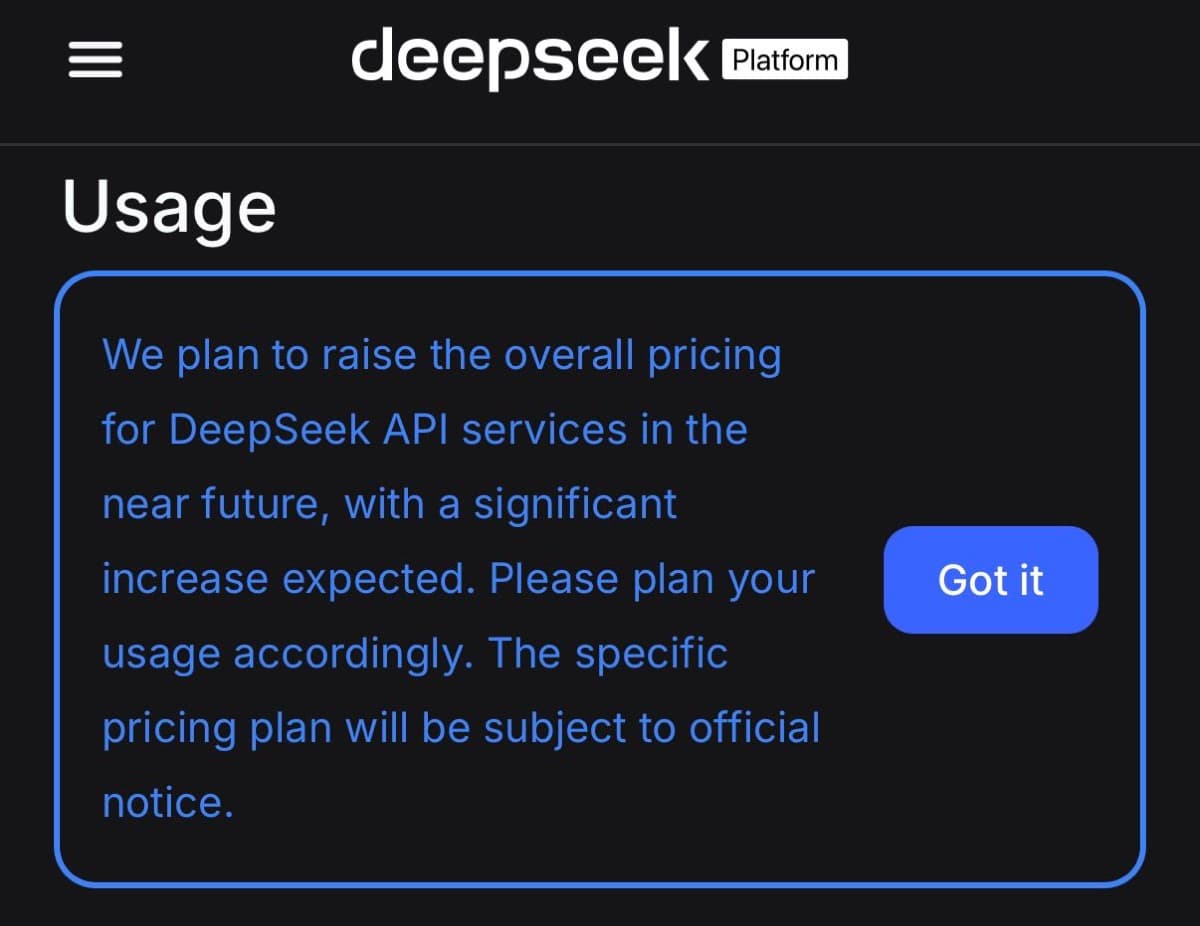
On August 6, 2026, DeepSeek, the Chinese AI company, officially announced that it will raise its API prices across the board, and by a significant amount. It also advised developers to "plan call volumes sensibly and adjust top-up amounts." The specific pricing and the start date will be confirmed in a later notice.
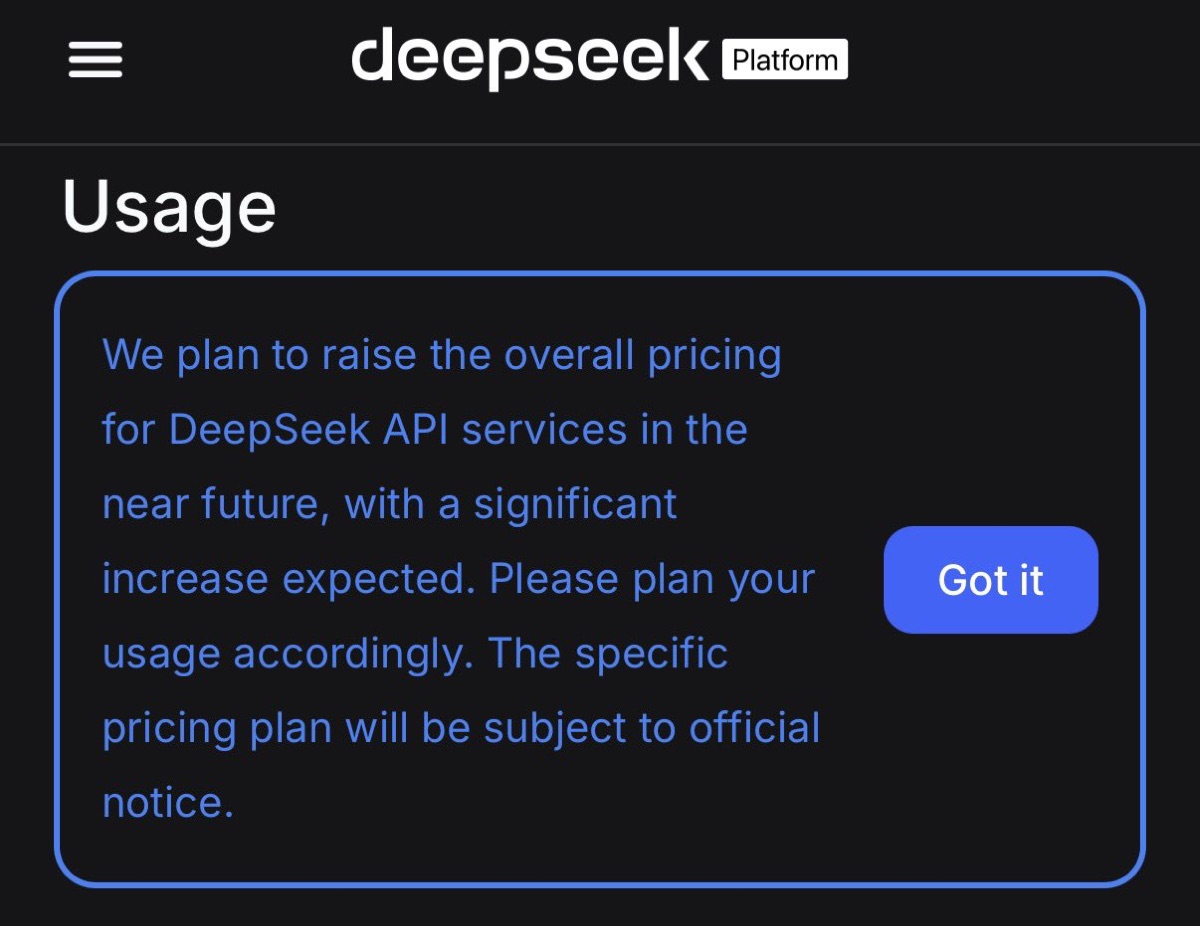
DeepSeek has shaken up the AI model market with ultra-low pricing. That it is now raising prices suggests the way we think about the cost of using AI has to change.
2x at Peak Hours: DeepSeek's New Price List
DeepSeek announced two changes.
Across-the-board price increase (announced)
The company said it plans to raise prices across its API services by a large amount. Details have not been released yet.
Peak/off-peak pricing (already announced)
This pricing was announced with the official V4 launch on June 29. Peak hours are 9 a.m. to 12 p.m. and 2 p.m. to 6 p.m. Beijing time (01:00-04:00 and 06:00-10:00 UTC), and every rate item is charged at 2x during those windows.
Current published prices (per 1 million tokens, in USD):
| Model | Input (cache hit) | Input (cache miss) | Output | At peak (x2) |
|---|---|---|---|---|
| V4-Flash | $0.0028 | $0.14 | $0.28 | Output $0.56 |
| V4-Pro | $0.003625 | $0.435 | $0.87 | Output $1.74 |
Why the Ultra-Low Pricing Is Ending: Compute Costs
This is not simply a move to charge more. Analysts read it in three different ways.
Strong demand and a compute shortage
Goldman Sachs said the increase is not a sign of weakening demand. Instead, it is evidence that demand for AI models remains strong and compute is scarce. In its view, the industry is moving away from the excessive price competition of the early days toward more sensible pricing.
IPO and infrastructure costs
Bloomberg reported that DeepSeek is under pressure to improve profitability as it aims for an IPO this year, and that infrastructure costs are weighing on it, including a 1 GW AI data center being built in Inner Mongolia.
An industry-wide trend
Major Chinese AI companies, including Alibaba Cloud, Tencent Cloud, Baidu, and Zhipu AI, have raised API prices repeatedly in 2026. Tencent raised prices twice and Zhipu AI three times. DeepSeek is now joining that trend.
In short, the era of ultra-cheap AI models is winding down. For anyone using AI in a real business, the skill that matters now is designing for cost, not just comparing unit prices.
4 Ways to Cut Costs Before Prices Rise
1. Raise your prompt cache hit rate
The cache-hit input price is a small fraction of the cache-miss price (for V4-Pro, input drops from $0.435 to $0.003625, about 1/120). If you keep system prompts and frequently used context fixed so the cache can be reused, input costs for the same work fall sharply.
2. Avoid peak hours
Move batch jobs to nights and weekends, and keep only the tasks that truly need real-time responses in peak hours. Simply designing around the 2x window can cut your cost in half.
3. Split models by task
Not every request needs a high-cost model. Send light tasks such as summarization and classification to a low-cost model, and reserve the high-performance model for core reasoning work.
4. Diversify your suppliers
DeepSeek has released its models as open source, so if prices rise too far, improved versions from other providers or self-hosting can be alternatives. Lining up at least one backup provider keeps you steady when prices move.
What Remains Is Usage Design, Not Unit Price
- DeepSeek announced a major API price increase on August 6. Details will come in a later notice.
- Under peak/off-peak pricing, rates double during set hours every day.
- The backdrop is strong demand and tight compute, IPO profitability pressure, and an industry-wide trend of price hikes.
- AI costs are now driven by usage design, not unit price. Using the cache, avoiding peak hours, splitting models, and diversifying suppliers are the basics of a practical response.
If you are considering AI automation, this DeepSeek price increase is a signal to shift the question from "which model should I use?" to "how should I design for cost?"