
If a search returns no results, DeepSeek does not charge for that request. The Search and Fetch APIs each cost $0.75 per 1,000 successful requests. But the two tasks are not combined into one billable request. What determines the cost is the actual number of successful requests.
Only requests with results are charged
DeepSeek set the price for both the Search API and the Fetch API at $0.75 per 1,000 successful requests. Failed requests and empty results are not charged.
| API | Price for successful requests | Not charged |
|---|---|---|
| Search API | $0.75 per 1,000 requests | Failed requests, empty results |
| Fetch API | $0.75 per 1,000 requests | Failed requests, empty results |
Costs do not add up simply because you sent a search request. Whether it returned actual results is part of the billing criteria. But that does not mean one research task equals one API request.
Same price, different jobs
The Search API finds webpages relevant to a query and returns structured results. It uses DeepSeek's own search engine. The Fetch API retrieves a webpage and returns its main content in Markdown.
If you select several pages from search results and read them, the calls are split between Search and Fetch. Successful requests for each are billed separately. Combine search and reading costs into one number, and you may miss the actual billing units.
Result count and number of calls are different
Search requests have a count field that sets how many results to return. The default is 10, and you can set it from 1 to 50. Getting 10 results does not mean you made 10 Search API calls.
Use need_content to decide whether to include page content in the search results. Its default is false. Set it to true to request page content in the search response's content field.
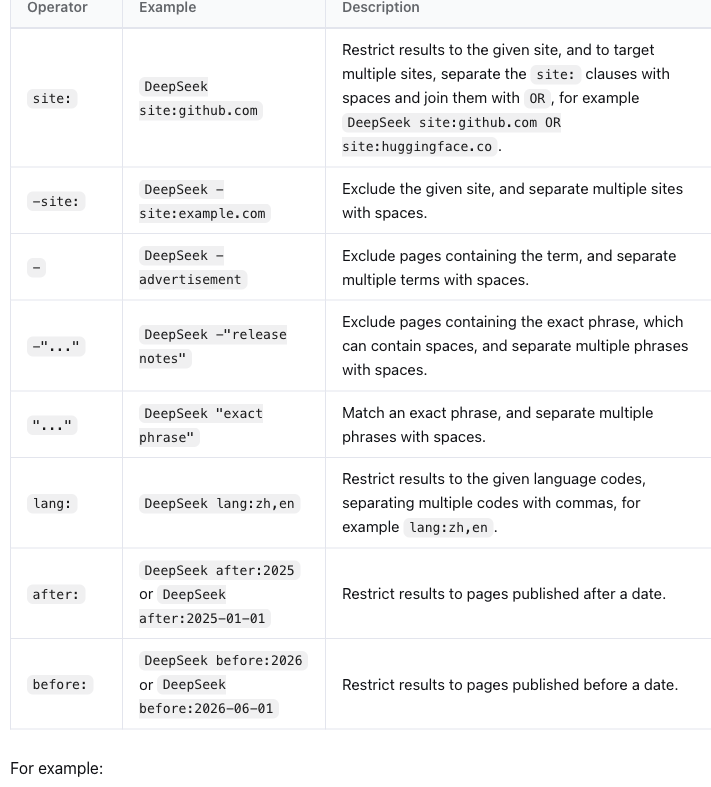 These settings are useful when designing a request, but the number of search results and the number of separate Fetch requests should be distinguished. Log calls to the Search API and Fetch API separately to calculate costs accurately.
Track call volumes during the free period
Server-side calls from DeepSeek Harness, Claude Code, and Codex are free through October 31. Per-request billing begins at 0:00 Beijing time on November 1.
The free period can be a chance to measure usage patterns. Count successful Search requests and successful Fetch requests separately, and keep failed requests and empty results distinct. Those records will help estimate costs once billing begins.
What would search cost for 100 daily research tasks?
Suppose you research 100 topics a day and make 20 searches for each topic. Over 30 days, that is 100 × 20 × 30, or 60,000 searches.
If all 60,000 are successful requests subject to billing, the Search API alone costs $45 per month. Failed requests and empty results are excluded from billing. This calculation does not include the cost of successful Fetch requests, which must be calculated separately.
Here is my take. Charging only for successful requests makes costs easier to estimate, but counting research tasks alone is not enough. You need to separate successful Search and Fetch requests to see the monthly cost.
In the end, count successful requests separately
Empty results and failed requests are not charged. But successful Search and Fetch calls each count as their own request. So what you need to track now is not just the number of research tasks, but the number of successful requests for each API.
There is one thing to check after free calls end. See how the actual bill compares with the successful request counts recorded during the free period.