Sundar Pichai, CEO of Google and Alphabet, said on his X account at 12:37 p.m. KST on August 22, 2026 that Gemini 3.7 Flash "broke the record for Gemini growth in its first week after launch." He called it "the fastest-growing model we've built" and added that the model now also powers Google Search and the Gemini app. (Source: X, Sundar Pichai, 2026-08-22)
The ARC-AGI verified scores Pichai cited
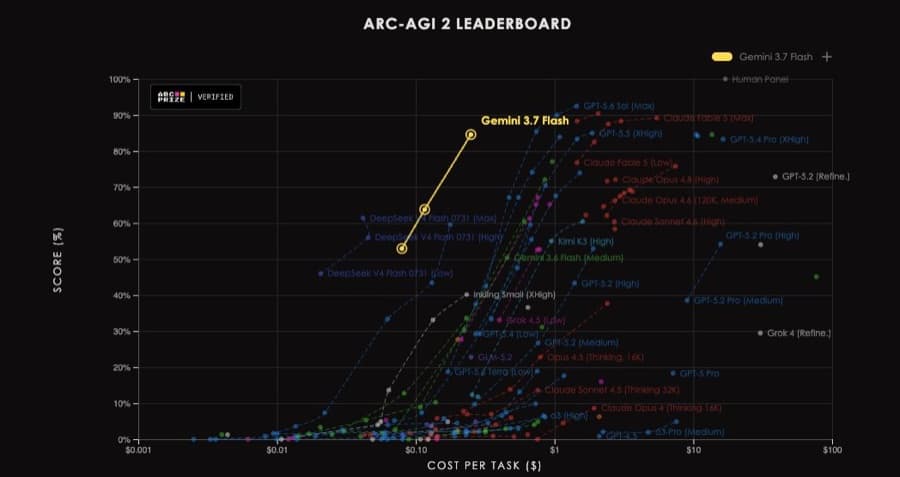
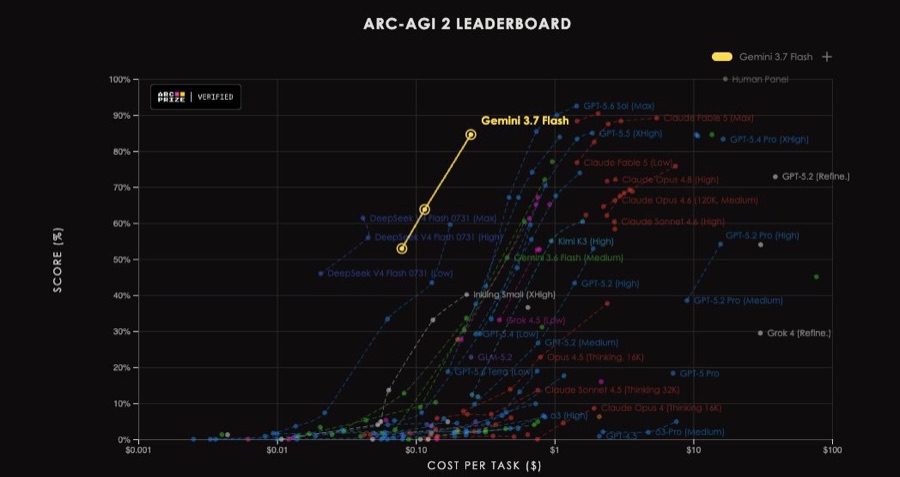
The post Pichai quoted is a verified result published by the official account of the benchmark organization ARC Prize at 3:04 a.m. KST on August 21, a day earlier. ARC Prize said "Gemini 3.7 Flash scored 84.6% on ARC-AGI-2 ($0.25 per task) and 95.5% on ARC-AGI-1 ($0.12 per task)," adding that "compared with other frontier models, it sits at a point where low cost and high scores appear together." (Source: X, ARC Prize, 2026-08-21)
In the cost-versus-score chart ARC Prize published, Gemini 3.7 Flash sits alone at a point that reaches a score range similar to top-tier models such as GPT-5.6 Sol and Claude Fable 5 at a much lower cost. Even if its score isn't the highest, it means almost no competing model sits in the same cost range.
The price increase comes January 1
According to the official Google DeepMind page, Gemini 3.7 Flash currently costs $0.75 per million input tokens and $3.75 per million output tokens. This is an introductory price that applies through December 31, 2026, and from January 1, 2027 it rises to $1.50 and $7.50 respectively. (Source: Google DeepMind official page)
The same page also publishes performance against the previous 3.6 Flash. On the software engineering benchmark DeepSWE v1.1 it scored 65.3%, up 16.7 points from 3.6 Flash (48.6%), and on AutomationBench, which measures enterprise workflow automation, it scored 30.4%, up 13.4 points. That is a big improvement for a successor released three weeks later.
Developers who try Gemini 3.7 Flash now still have a window to get a roughly half-price introductory rate along with the latest benchmark scores. But the cost structure changes after the switch to standard pricing on January 1, 2027, so if you plan to put heavy traffic on it, factor that date into your cost calculations first.