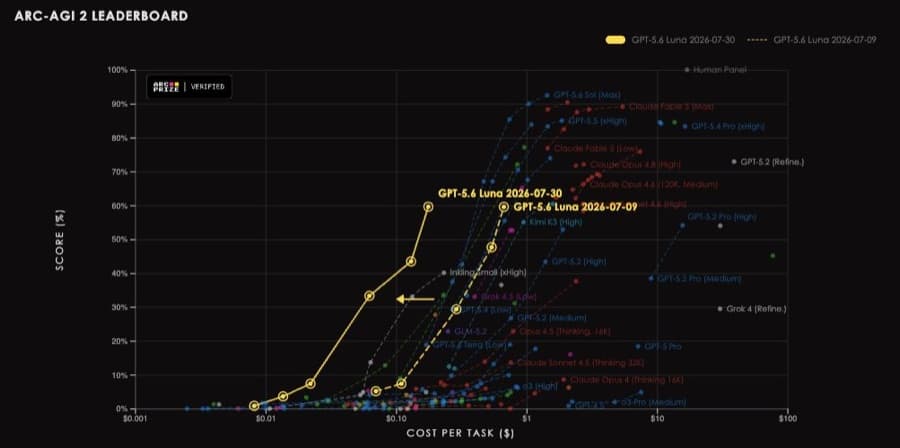
Prices fell 80%, and reasoning performance held? ARC Prize retested OpenAI's GPT-5.6 Luna on ARC-AGI (Verified) after the price cut. The result was the same score as before the cut, at a much lower cost.
Retaking the Test After the Price Cut: ARC Prize's Question
OpenAI recently cut GPT-5.6 Luna's price by 80%. To check whether performance fell along with the price, ARC Prize reevaluated the same model using the Verified method. Here, "Verified" refers to a procedure that lets results be reproduced through independent runs.
59.6% on ARC-AGI-2, 90.7% on ARC-AGI-1: The Change in Numbers
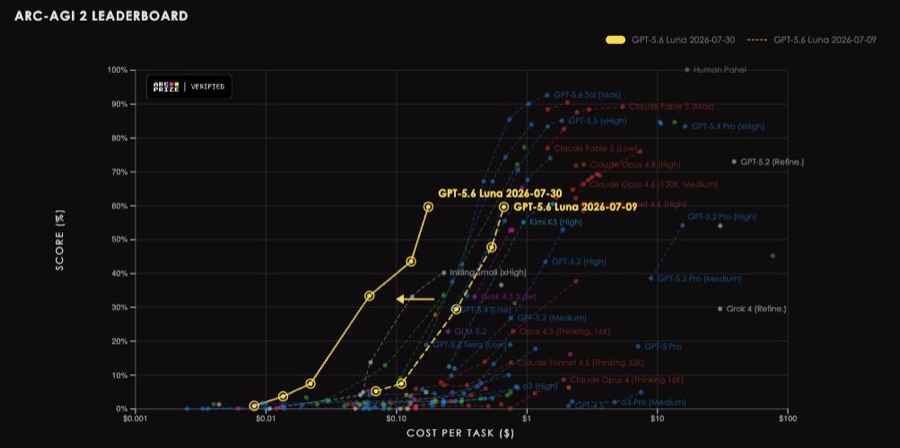
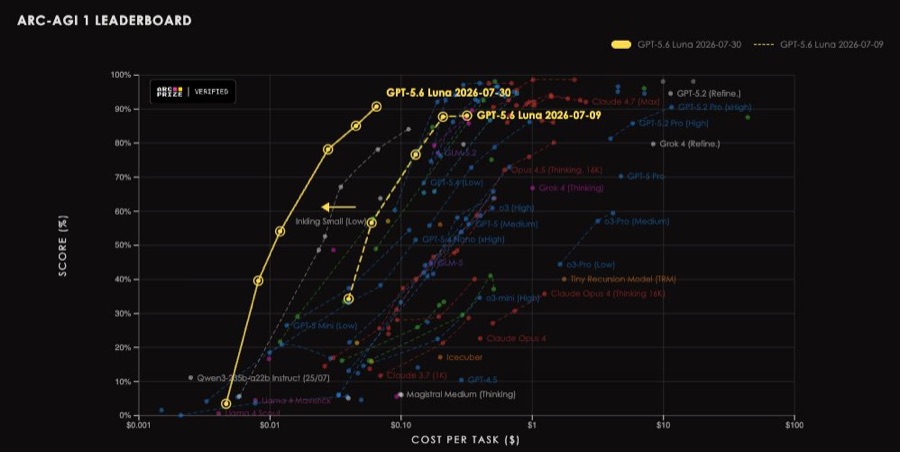
Here are the results. Luna scored 59.6% on ARC-AGI-2 and 90.7% on ARC-AGI-1, the same as its original performance before the cut. ARC-AGI-2 is the harder, newer benchmark.
| Benchmark | Score | Cost (per task) |
|---|---|---|
| ARC-AGI-2 | 59.6% | $0.18 |
| ARC-AGI-1 | 90.7% | $0.07 |
How Cost per Task Changes Model Choice
The point is not the absolute score but performance per dollar: $0.07 per task on ARC-AGI-1 and $0.18 on ARC-AGI-2. ARC Prize's takeaway fits in one line: "It kept the same performance as before the cut at a much lower cost."
Why an 80% Cut? Luna's Efficiency Gains
OpenAI credited efficiency in its internal model development. Luna fell from $1 to $0.20 per million input tokens, and from $6 to $1.20 for output (GPT-5.6 Terra got a 20% cut around the same time). The background is that optimizing its own inference pipeline cut serving costs by 20% and raised token generation efficiency by more than 15%.
Why This Result Matters to Developers
ARC-AGI is a leading benchmark for "reasoning ability." Performance holding while prices fall means there is now room to reconsider reasoning-heavy work you dropped because of cost. Research and evaluation workflows that run benchmarks often, in particular, can enjoy a cost per task that is about one-fifth.
Related: X post (ARC Prize) · Full ARC Prize results