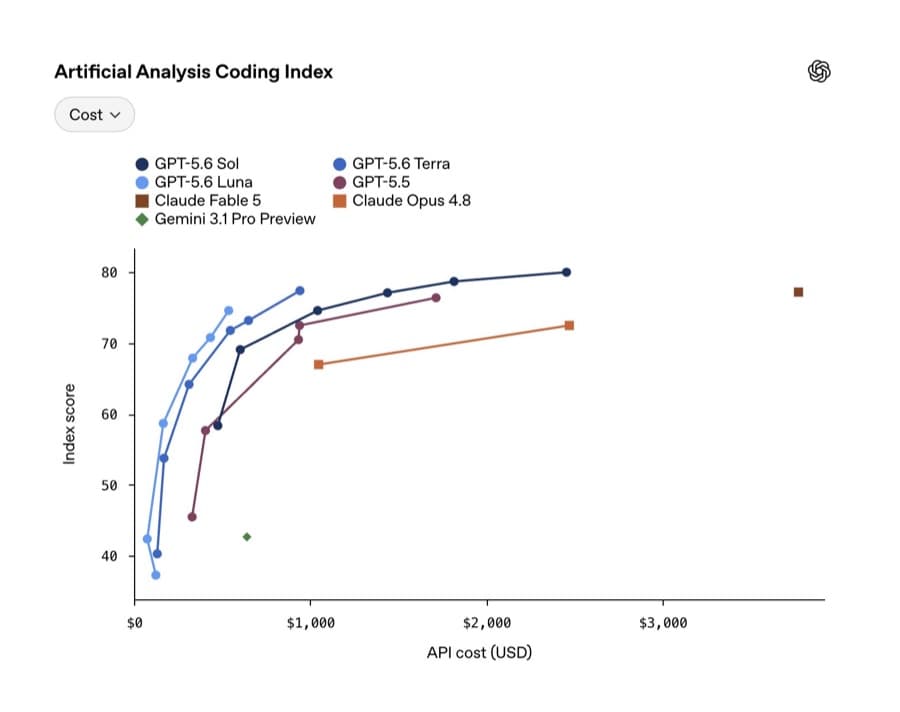
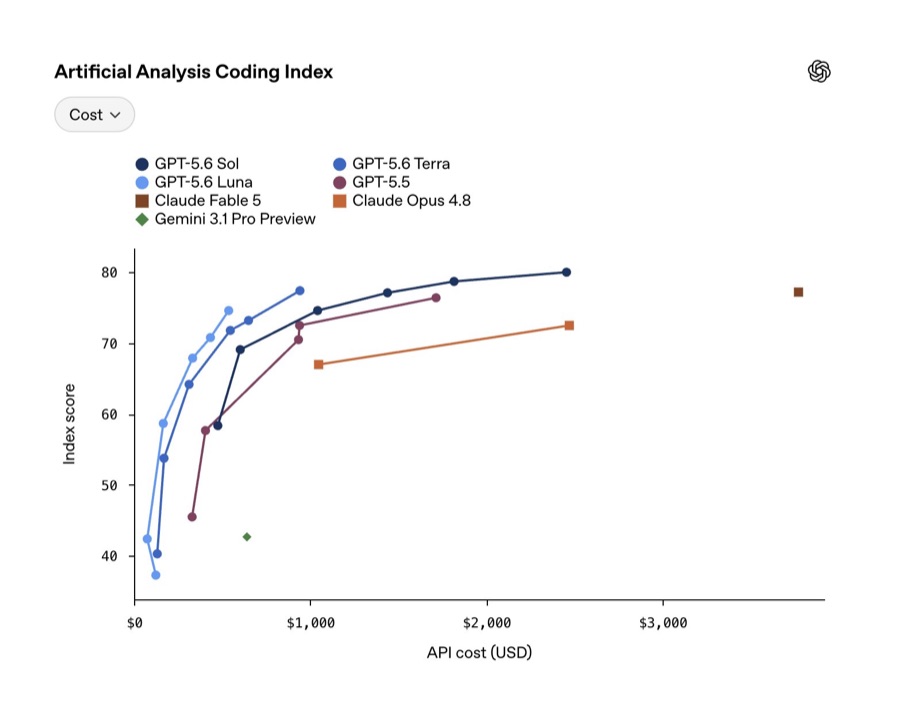
On August 18, 2026, OpenAI's official developer account @OpenAIDevs posted a thread on X summarizing its blog post "The builder's guide to GPT-5.6."
It says the company worked with teams across industries to see how smarter model choice, reasoning, and tool calling lower agent costs. The detailed cases are in the official blog post.
The heart of it is the numbers. Results from four companies that actually adopted it are laid out in specifics.
Hypha: 98% Accuracy at 1/18 the Cost
Real estate startup Hypha put GPT-5.6 Luna on a document extraction task.
According to OpenAI's official blog, accuracy stayed at about 98% of GPT-5.5.
At the same time, costs fell to 1/18 by the official announcement.
It's a case of cutting cost sharply without giving up much accuracy. For teams that process lots of documents, it's a reason to test a cheaper model first instead of a top-tier one.
Rogo: Tool Calling Alone Cut Tokens 21%
Financial research startup Rogo took a different approach. Instead of lowering the model tier, it had the model collect and analyze filings directly through programmatic tool calling.
According to the official blog, this cut input tokens by 21% while maintaining evaluation quality.
It means there's more than one way to cut costs. Before anything else, check whether tool-calling design alone could reduce token consumption without changing the model.
Sol: 3x the Score, 1/6 the Tokens
GPT-5.6 Sol, with retained reasoning and compaction techniques applied, raised its ARC-AGI-3 benchmark score from 13.3% to 38.3%, according to the official blog.
It used about one-sixth of the previous output tokens to do so.
The cost-to-performance gap also shows up in another benchmark the official blog introduced. GPT-5.5 (Extra High) cost $33.27 to score 84.36% on the BrowseComp benchmark.
GPT-5.6 Luna (Extra High), by contrast, reached effectively the same performance for $1.33, the same source says.
That's why each team should build its own cost comparison table to decide which model tier to validate first for the same performance.
Hex and Ramp: Why Low Reasoning Worked
Some cases have no quantitative figures. Izzy Miller, AI research lead at code research tool Hex, said this on the official blog:
"When we put GPT-5.6 in our harness, we got the best results at low reasoning effort. It noticed that the data wasn't there, didn't chase false leads, and reached the right answer with fewer tokens."
Ian Tracey, a software engineer at fintech company Ramp, also left a conclusion from a different angle on the same official blog.
"GPT-5.6 was less a chat assistant and more a technical operator that handles things end to end. It inspected live systems, debugged issues, fixed code, verified results, and shipped deliverables, and it kept context solid over long sessions."
Putting the four results in a table shows the differences in approach.
| Startup | Approach | Result |
|---|---|---|
| Hypha | GPT-5.6 Luna on document extraction | 98% accuracy kept, cost cut to 1/18 |
| Rogo | Programmatic tool calling to collect and analyze filings | Evaluation quality kept, input tokens down 21% |
| Hex | Low reasoning effort in a code research harness | Correctly recognized missing data, reached the right answer with fewer tokens |
| Ramp | Delegated system inspection, debugging, code fixes, and result verification | Kept context over long sessions and handled work through to deliverables |
They share one thing. They didn't simply move up to a bigger model; they first tuned reasoning effort and tool-calling design.
Why Aren't GPT-5.6 Prices Listed?
Some things can't be confirmed from this announcement. The GPT-5.6 lineup consists of Sol, a high-performance reasoning model, and Luna, known as the fastest and cheapest model.
But the exact pricing policy for each model isn't the main subject of the official blog post. This article doesn't cover specific price figures that can't be reproduced from official materials.
Also, all the figures above come from specific workloads. Whether they carry over to other work or other datasets is something each team has to re-verify in its own environment.
If you're considering adoption, it's safer to pick the case closest to your work, whether document processing, research, coding, or system operations, and test it at small scale first.
The announcement was also covered in international media reports.