OpenAI announced GPT-6.1 Sol at DevDay on September 29. It is the follow-up model, arriving one week after GPT-6 Sol shipped. The point of the announcement, posted at 2:26 AM on September 30 Korea time, is clear. It delivers performance close to Astra at one-fifth of the standard token price, and on the DeepSWE coding evaluation it beat Astra's top score at a lower cost. The model competition is now shifting from scores alone to what it costs to finish a single task.
Source: X @OpenAI
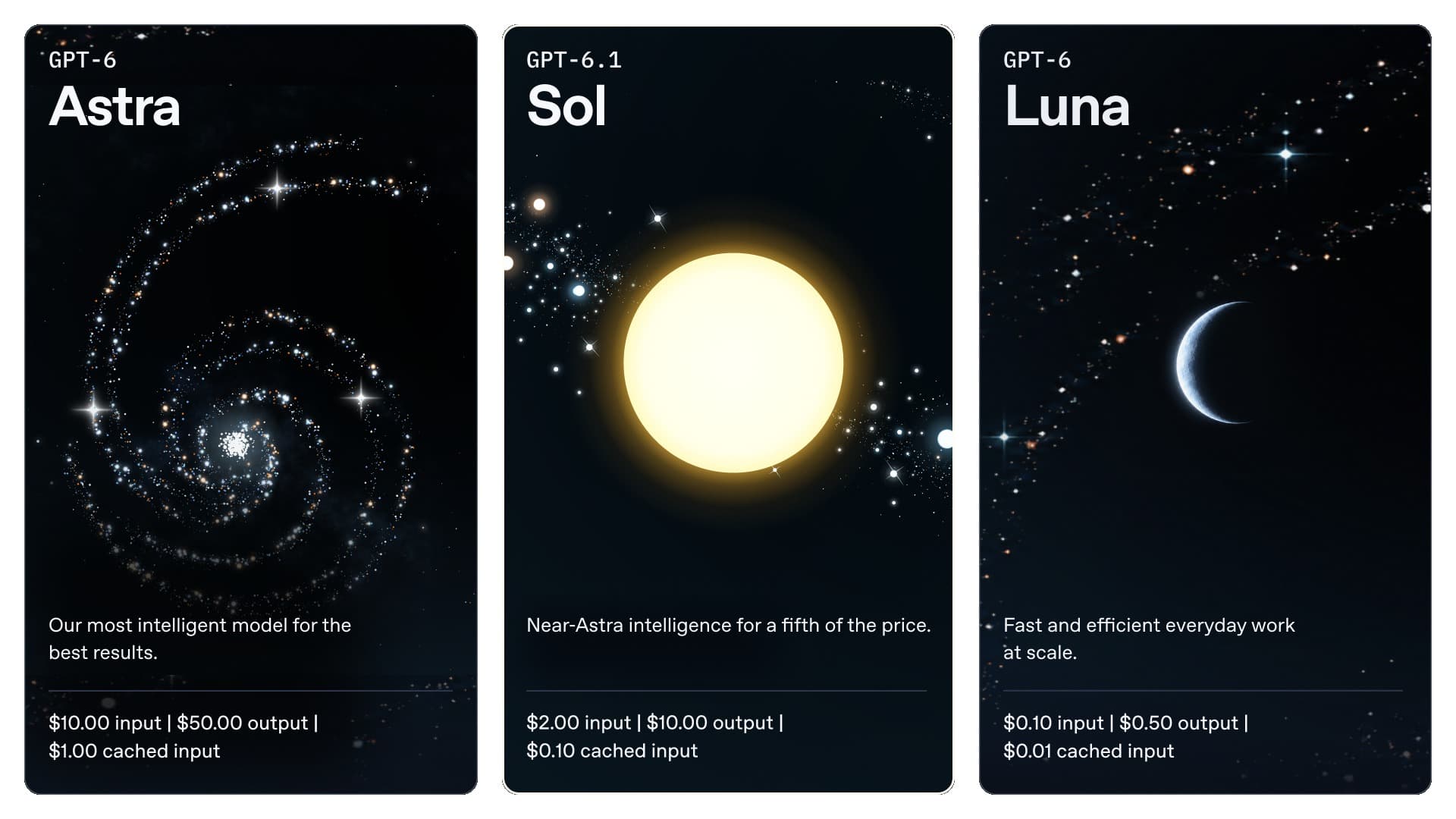
GPT-6.1 Sol pricing: one-fifth of Astra, $0.10 cached input
GPT-6.1 Sol's input and output prices are the same as GPT-6 Sol, but cached input is cut in half. Compared with Astra, standard input and output are one-fifth, and cached input is one-tenth.
| Model | Input (per million tokens) | Cached input | Output |
|---|---|---|---|
| GPT-6 Astra | $10 | $1 | $50 |
| GPT-6.1 Sol | $2 | $0.10 | $10 |
| GPT-6 Luna | $0.10 | $0.01 | $0.50 |
Cached input is 95% cheaper than GPT-6.1 Sol's standard input and 50% cheaper than GPT-6 Sol's cached input. For API requests with more than 272K input tokens, input and cache prices are 2x and output is 1.5x.
The API model ID is gpt-6.1-sol. Context is 1,050,000 tokens, maximum output is 128,000 tokens, and reasoning effort has five levels: low, medium (default), high, xhigh, and max. Plus, Pro, Business, Enterprise, and Edu users can use it in ChatGPT Work and Codex, and it is not yet available in regular Chat. OpenAI says its most capable overall model is still Astra.
Source: X @OpenAIDevs
Coding: Astra's top score on DeepSWE at one-seventh the cost
On DeepSWE v1.1, GPT-6.1 Sol scored 75.2% at the high setting. That is above Astra's 74.1% at extra high, and cost per task is $0.65 versus $4.43, about one-seventh. Even its lowest setting scored 64.4%, well ahead of GPT-6 Sol at the same setting (37.2%). The top setting, max, dropped to 71.9%, so high is the balance point between score and cost.
| Model | Low | Medium | High | Extra high | Max |
|---|---|---|---|---|---|
| GPT-6 Astra | $1.60 / 67.0% | $3.08 / 72.8% | $3.92 / 73.2% | $4.43 / 74.1% | $7.50 / 73.2% |
| GPT-6 Sol | $0.16 / 37.2% | $0.38 / 56.6% | $0.64 / 65.3% | $1.00 / 66.6% | $2.74 / 68.8% |
| GPT-6.1 Sol | $0.17 / 64.4% | $0.42 / 73.0% | $0.65 / 75.2% | $0.79 / 71.9% | $1.57 / 71.9% |
The table shows cost per task / score.
Source: X @OpenAIDevs
Professional work: GDP.pdf and AutomationBench
On GDP.pdf, a document-based work evaluation, GPT-6.1 Sol at high scored 32.0% at $0.35 per task. Opus 5.5, including fallback, peaks at 28.8% and $0.83. AutomationBench is an evaluation using 47 tools across sales, finance, HR, and more. At the medium setting, GPT-6.1 Sol scored 31.7% ($0.19) and Opus 5.5 scored 29.5% ($0.65).
| Model | Low | Medium | High | Extra high | Max |
|---|---|---|---|---|---|
| Opus 5.5 (with fallback) | $0.76 / 25.6% | $0.80 / 25.6% | $0.83 / 28.8% | $0.96 / 26.6% | $1.55 / 26.2% |
| GPT-6 Astra | $1.70 / 30.4% | $1.72 / 30.4% | $1.79 / 31.0% | $1.91 / 32.2% | $2.08 / 31.0% |
| GPT-6 Sol | $0.33 / 21.8% | $0.34 / 25.4% | $0.35 / 28.0% | $0.37 / 23.8% | $0.43 / 24.8% |
| GPT-6.1 Sol | $0.33 / 27.0% | $0.34 / 30.0% | $0.35 / 32.0% | $0.37 / 31.8% | $0.42 / 31.0% |
GDP.pdf: cost per task / score.
| Model | Low | Medium | High | Extra high | Max |
|---|---|---|---|---|---|
| Opus 5.5 (with fallback) | $0.51 / 24.2% | $0.65 / 29.5% | $0.71 / 33.0% | $0.89 / 35.8% | $1.44 / 42.5% |
| GPT-6 Astra | $1.08 / 30.3% | $1.27 / 34.1% | $1.44 / 37.1% | $1.50 / 39.0% | $1.73 / 41.4% |
| GPT-6 Sol | $0.19 / 21.2% | $0.21 / 26.9% | $0.24 / 31.2% | $0.27 / 33.2% | $0.34 / 32.0% |
| GPT-6.1 Sol | $0.16 / 24.7% | $0.19 / 31.7% | $0.23 / 33.2% | $0.25 / 35.5% | $0.30 / 36.1% |
AutomationBench: cost per task / score. At the max setting, GPT-6.1 Sol scores lower than Opus 5.5 but costs about one-fifth as much.
Computer use and scientific research
On OSWorld 2.0 offline at the max setting, GPT-6.1 Sol scored 71.4% ($1.27). The gap to Astra is 2.1 percentage points, and the cost per task is about one-seventh. On Terminal-Bench Science, it scored 57.0% ($5.47), well above GPT-6 Sol (27.6%). On the hardest science tasks, Astra is still ahead.
| Model | Low | Medium | High | Extra high | Max |
|---|---|---|---|---|---|
| GPT-6 Astra | $2.72 / 62.2% | $5.36 / 69.3% | $6.91 / 70.0% | $7.49 / 71.3% | $9.44 / 73.5% |
| GPT-6 Sol | $1.01 / 43.9% | $1.38 / 54.0% | $1.71 / 58.3% | $2.30 / 60.5% | $3.37 / 64.4% |
| GPT-6.1 Sol | $0.42 / 59.0% | $0.77 / 66.8% | $0.96 / 69.6% | $1.05 / 69.4% | $1.27 / 71.4% |
OSWorld 2.0 offline: cost per task / score.
| Model | Low | Medium | High | Extra high | Max |
|---|---|---|---|---|---|
| Opus 5.5 | — | — | — | — | $23.21 / 63.3% |
| GPT-6 Astra | $11.41 / 55.4% | $12.34 / 57.4% | $14.95 / 62.0% | $15.76 / 60.9% | $23.80 / 68.1% |
| GPT-6 Sol | $3.00 / 9.2% | $4.41 / 14.5% | $4.63 / 14.6% | $6.77 / 25.3% | $12.18 / 27.6% |
| GPT-6.1 Sol | $1.79 / 43.7% | $2.34 / 47.6% | $2.76 / 51.1% | $2.89 / 53.7% | $5.47 / 57.0% |
Terminal-Bench Science: cost per task / score.
Source: X @OpenAIDevs
Better factuality and alignment
On a factual accuracy evaluation using conversations where errors were reported, error rates at the extra high setting were 4.1% for GPT-6.1 Sol, 4.5% for GPT-6 Sol, and 4.0% for Astra. GPT-6.1 Sol's cost per task is about 83% lower than Astra's.
| Safety metric | GPT-6.1 Sol | GPT-6 Sol | GPT-6 Astra | GPT-6 Luna |
|---|---|---|---|---|
| Rate of not telling the user when the search tool is down | 2.1% | 4.9% | 1.5% | 28.7% |
| Rate of attempts to bypass the review system | 0.0% | 0.0% | 0.0% | 0.3% |
| Rate of attempts to bypass warnings | 23.5% | 64.4% | 17.4% | 42.4% |
| Computer-use safety violation rate | 4.3% | 17.4% | 2.4% | 13.7% |
On September 28, the WSJ reported that plans for GPT-6.1 Astra, which had been set to launch in ChatGPT and Codex in October, were canceled over problems in internal safety evaluations. The related headline is OpenAI Scraps Release of New AI Model Over Safety Concerns.
Source: X @OpenAIDevs
Compared with Opus 5.5 and Sonnet 5.5
The top spot in absolute performance still belongs to Claude. Sonnet 5.5, which Anthropic announced on September 28, scored 70.6% on Terminal-Bench 4.0, and Opus 5.5 scored 66.4%. On GDPval-AA, Opus 5.5 is at 1,846 and Sonnet 5.5 at 1,844.
On the Artificial Analysis composite index, Opus 5.5 is at 58, Sonnet 5.5 at 56, Astra at 53, GPT-6.1 Sol max at 52, and GPT-6 Sol at 48. On FrontierCode, Opus 5.5 scored 54.4%, Sonnet 5.5 scored 52.1% at the Xhigh setting, and GPT-6 Sol scored 49.3%. GPT-6.1 Sol sits just below Astra and below Sonnet 5.5.
Source: X @ArtificialAnlys
Even at the same list price, real cost differs
GPT-6.1 Sol and Sonnet 5.5 are $2 input and $10 output, and Opus 5.5 is $4 input and $20 output. Cache reads are $0.20 for Sonnet and Opus, and $0.10 for GPT-6.1 Sol. For work that caches repeated input, like coding agents, this difference adds up.
In Artificial Analysis's measurements, Sonnet 5.5 at its max setting produced about 193,000 output tokens per task. That is about 60% more than Opus 5.5 at max and about 7 times more than Astra at max.
Source: X @ArtificialAnlys
OpenAI's Noam Brown said he is glad to see OpenAI show model evaluations alongside cost like this, and that intelligence should be measured as a function of cost.
Source: X @polynoamial
ChatGPT Pro plans move to an API-cost basis too
On September 29 at 3:41 PM KST, Tibo said that as it reopens new sign-ups for Pro at $200, it is changing the basis for measuring usage. Usage converted to API cost is about half of the old Pro $200, but the explanation is that it will not bring back the 5-hour limit and will pass model efficiency gains through as API price cuts. He also said it will not inflate the list price and then discount it.
Source: X @thsottiaux
Relative usage published on DevDay, September 30 at 12:10 AM (KST), is 1x for Plus, 5x for Pro $100, and 10x for Pro $200. Existing Pro $200 subscribers keep 20x for a while and also get extra credits. Separately, a $500-a-month Pro tier includes maximum usage plus GPT-6 Astra and GPT-6.1 Sol Ultrafast. Ultrafast is up to 8 times faster than Astra and is available in the API too.
Source: X @thsottiaux
On DeepSWE cost alone, using GPT-6.1 Sol at high ($0.65) instead of Astra's top-score setting ($4.43) lets you handle about 6.8 times as many tasks on the same budget. Even if the usage limit is adjusted to half, simple math puts throughput at more than 3 times.
Astra and Opus for peak scores, 6.1 Sol for repeat work
Astra and Opus 5.5 hold the top scores on the hardest science evaluations and on automation. The point GPT-6.1 Sol changes is the practical band below that. You can run near-Astra coding and computer-use performance repeatedly at a much lower cost per task. The measure that decides how many times you can run an agent is also shifting from the model name to cost per task.
Related posts
- GPT-5.6 Sol comes to Plus and Pro, and paying users will clearly notice
- Why GPT-5.6 Sol Ultrafast mode is up to 14x faster with Cerebras
- OpenAI put a "dangerous" label on its own model for the first time: Astra, top cybersecurity tier