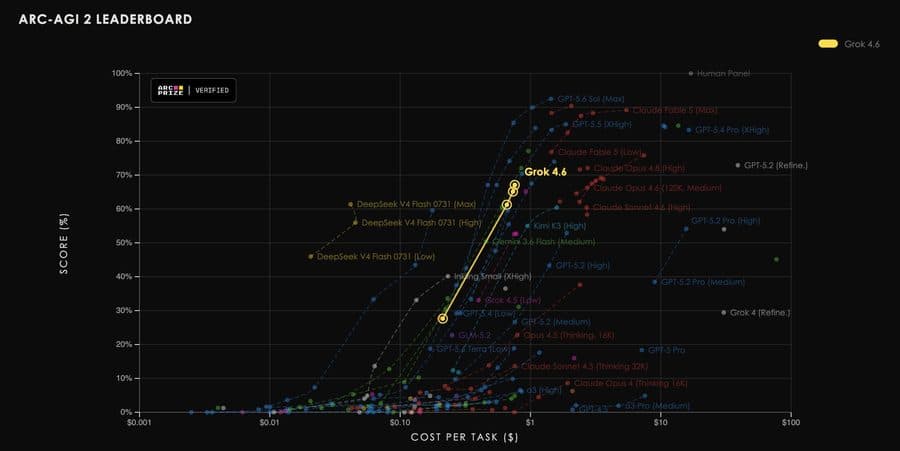
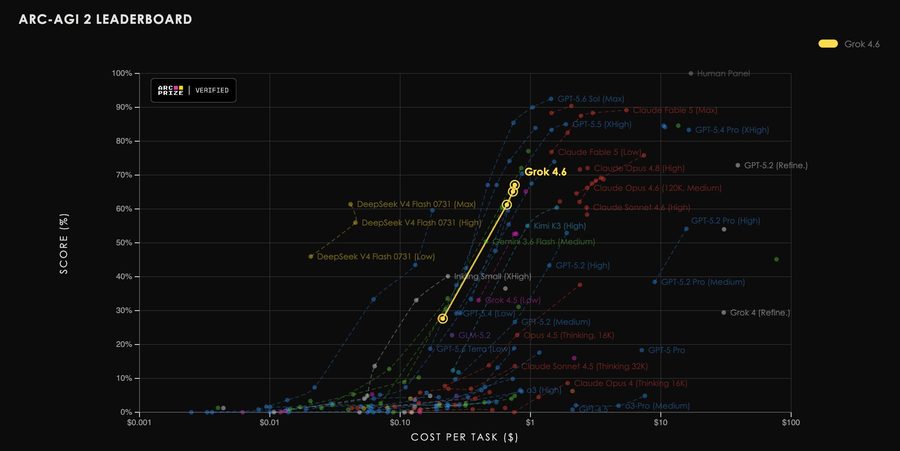
ARC Prize published its verification results for Grok 4.6.
ARC Prize is a nonprofit benchmark foundation created by François Chollet and Mike Knoop. Rather than numbers released by a model's maker, the foundation runs the model itself through the API, scores it, and then attaches a "Verified" badge, so it is highly credible.
Where Does Grok 4.6 Stand Across the Three ARC-AGI Levels?
The verified results the official ARC Prize X account posted at 10:20 a.m. KST on August 14 are as follows (original post).
| Test | Score | Cost per task |
|---|---|---|
| ARC-AGI-1 | 87.5% | $0.30 |
| ARC-AGI-2 | 67.1% | $0.76 |
| ARC-AGI-3 | 2.11% | $5,600 |
ARC-AGI-1 and 2 are static reasoning problems, and ARC-AGI-3 is an agent-style problem that requires interaction. Difficulty rises sharply as you go, so scores fall along with it.
Performance for the Cost: Level With GPT-5.6 Sol at a Third of the Price
What ARC Prize also pointed out was cost efficiency on ARC-AGI-3.
Grok 4.6 in xhigh reasoning mode posted a score similar to GPT-5.6 Sol in high reasoning mode. But the cost was $5,600 per task, about a third of Sol's $15,200.
All three charts carry the "Verified" mark on the official ARC Prize leaderboard, which makes clear these are third-party verified results, not self-run benchmarking.
Look at the Cost Curve, Not Just the Score
ARC-AGI scores may look far removed from everyday work. But what this benchmark measures is how well a model solves new, unstructured problems.
When you attach a model to work with no set answer, like coding agents or research automation, you need to look at the cost curve relative to score as in this case, not just raw accuracy, to gauge real operating costs.
For reference, when xAI officially announced Grok 4.6 on August 12, it led with its own metrics such as the AA Intelligence Index, GDPVal-AA, and CursorBench. The ARC-AGI figures are not in xAI's official announcement and appear only in this independent verification by ARC Prize, which is how third-party benchmarks normally work.
These Are Costs at a Specific Reasoning Effort
These figures are the latest verified values published by ARC Prize, and as of writing, no reproduction by another independent organization has been found. Costs like the $5,600 and $15,200 on ARC-AGI-3 are for specific reasoning effort settings (xhigh and high), so cost and score can both change if you lower the setting.
Before choosing a model, we recommend running a small test yourself under conditions similar to your own workload.