Legal tech startup Harvey (@harvey) released "Tenet," its first in-house legal AI model, at 12:03 a.m. KST on August 21, 2026. It is built on Moonshot AI's open-weights model Kimi K3 and was post-trained together with Fireworks AI (@FireworksAI_HQ).
Performance, based on published data
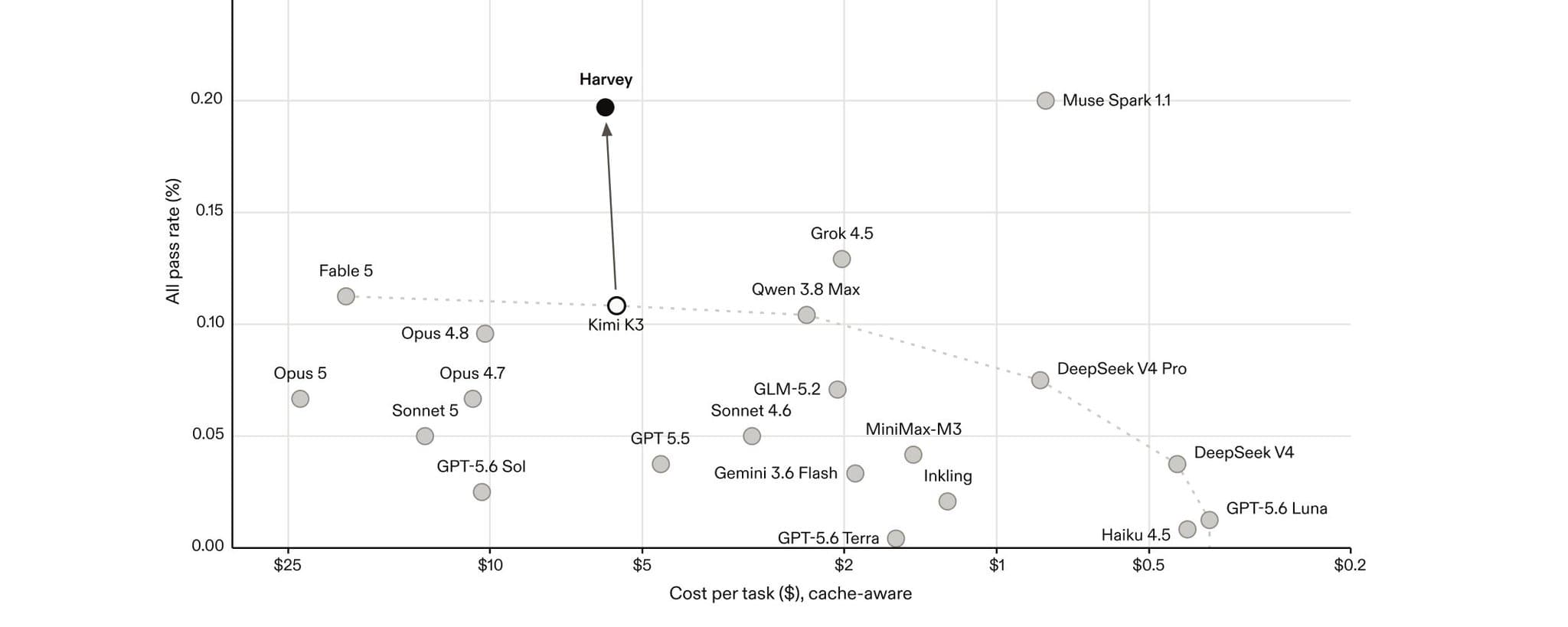
According to Harvey's official announcement (Harvey blog), Tenet improved its overall pass rate on Harvey's own "LAB" benchmark by 82% over the Kimi K3 base model. On "LAB Contracts," a benchmark focused on contract review, it improved by 22% and took first place. It ranks second overall on LAB.
In the chart attached to the announcement, Tenet sits in roughly the same cost-per-task range as Kimi K3 but with a clearly higher overall pass rate. Harvey says its cost is less than a quarter of top-tier foundation models such as Opus 5 and Fable 5.
Three subagents trained on legal data
Three specialized subagents were released alongside Tenet. The M&A due diligence model was post-trained with Baseten, the model for building Review Tables with Applied Compute, and the model for searching a law firm's internal knowledge with EngramLab. All three are described as optimized for large, long-running tasks.
The training data consists of public legal materials, synthetic data, and simulated litigation and contract scenarios created with real attorneys. Harvey says the release is part of its "Harvey II" rollout, which also includes a new memory feature.
What this means in practice
It is notable that a US legal tech company built its own commercial model on top of a Chinese open-weights model (Kimi K3). It shows how a company can tune an open-weights model for a specific line of work without being locked into a single vendor.
For legal professionals, it means a specialized model can handle repetitive work such as contract review and M&A due diligence at lower cost. For now, though, it is available only to Harvey platform users, so most people outside that customer base cannot try it directly.
What still needs confirmation
LAB and LAB Contracts are both Harvey's own benchmarks, and no third party has independently verified the numbers. The specific comparison targets and the method behind the "less than a quarter of the cost" claim have not been published beyond Harvey's original announcement.