"The Industry AI Was Supposed to Kill Got Bigger Instead"
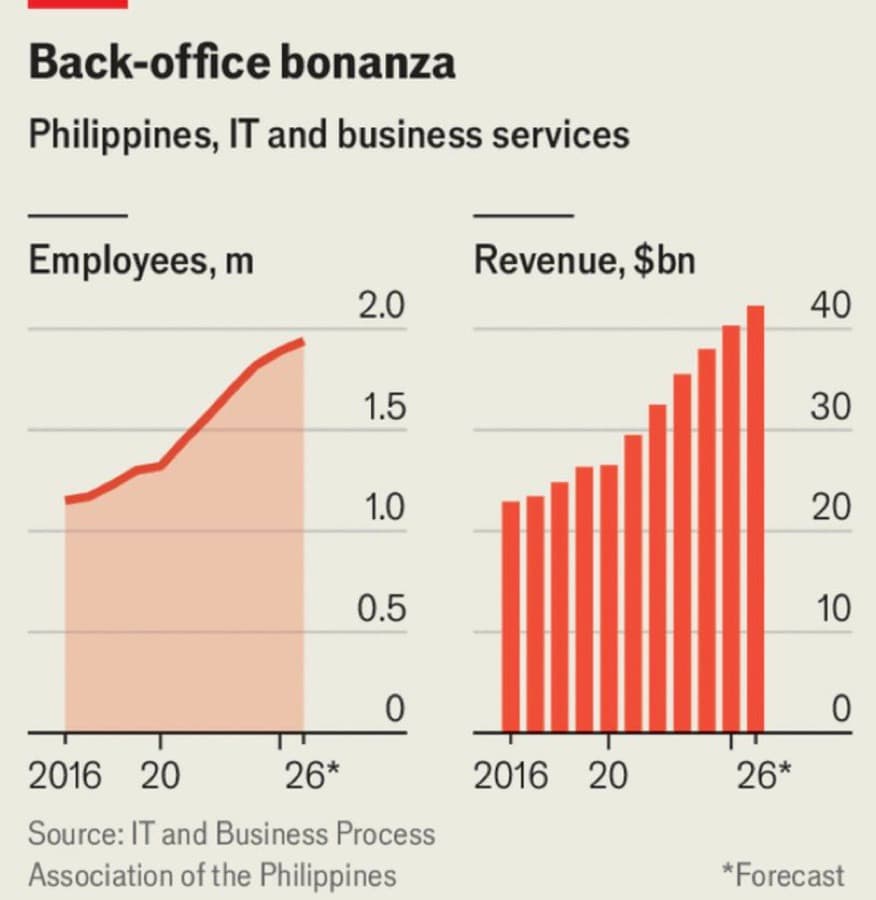
On August 9, Trung Phan (@TrungTPhan), known as a writer for the startup newsletters The Bear Cave and Not Boring, posted an interesting chart. It was an Economist-style graph of employment and revenue in the Philippine IT and business process management (IT-BPM) industry. He wrote, "Since ChatGPT launched, the Philippines' offshoring industry (8% of GDP) has gotten much bigger. IT and business outsourcing employment is up 20% to 1.9 million, and industry revenue is up 30% to $42 billion." The post drew more than 130,000 views, 1,000 likes, and 212 reposts in a day.
The reason these numbers feel strange is clear. After generative AI arrived, the first jobs singled out for disappearance were low-value outsourcing tasks like call centers, data entry, and back-office work. The forecast that "AI will wipe out call centers" has been repeated steadily since ChatGPT launched. Yet in the Philippines, the epicenter of that industry, both employment and revenue rose at the same time.
The Gap Between Conventional Wisdom and the Data: What Actually Happened
Checking the numbers directly, the X post's description and the actual industry statistics broadly line up. The reference dates differ a bit, though, so they need checking. Just before ChatGPT was released to the public in November 2022, the Philippine IT-BPM industry had annual revenue of $32.5 billion and 1.57 million full-time jobs (Manila Bulletin, 2023). The industry association IBPAP targets $42 billion in revenue and about 1.97 million jobs by the end of 2026, and as of the end of 2025, employment had already reached about 1.9 million and revenue around $40 billion (Outsource Accelerator, 2026).
In short, versus the ChatGPT launch, employment is up about 21% and revenue about 29%, nearly matching the "+20%, +30%" figures the X post cited. The industry's share of Philippine GDP is also about 8.2%, consistent with the "8% of GDP" mention (BusinessMirror, 2026). We should note, though, that we couldn't directly compare the original Economist article and its chart ("Back-office bonanza") in this check, and we cross-verified using figures from IBPAP's official roadmap document (IBPAP Roadmap 2028 PDF).
| Item | Just before ChatGPT launch (2022) | 2026 (estimate/target) | Growth |
|---|---|---|---|
| Full-time employment | About 1.57 million | About 1.9–1.97 million | About +21–25% |
| Industry revenue | About $32.5 billion | About $40–42 billion | About +23–29% |
| Share of Philippine GDP | - | About 8.2% | - |
Sources: combined from Manila Bulletin (2023), Outsource Accelerator (2026), BusinessMirror (2026), and the figures cited in the X post (@TrungTPhan)
Amplification, Not Replacement: A Signal for Organizations Everywhere, Including in Korea
What makes this data interesting isn't the simple conclusion that "AI didn't eliminate jobs." What IBPAP and other industry officials actually say is that while AI absorbed low-skill repetitive work, people moved to more complex work that requires judgment (AMRO Asia, 2026). Instead of call center agents being pushed out by AI chatbots, staff were reassigned to exception cases left after AI handled the first response, customer retention, and quality control. As the workload and revenue contribution per person rose, industry revenue grew faster than the rate of job growth.
This is a signal that can apply the same way to startups and companies elsewhere, including in Korea. Organizations that approach AI adoption only as a justification for cutting headcount and organizations that design AI as a lever to expand existing staff's capacity get completely different results from the same technology. For teams with a high share of repetitive work, such as customer support, operations, and back office, the design needs to redirect the time AI frees up toward higher-value work like service quality, churn prevention, and data-driven decisions instead of layoffs. The Philippine case is closer to four years of empirical data showing that such redeployment can actually translate into revenue growth.
Is AI Behind the Job Growth?
But we need to be clear that this article starts from a single X post. Trung Phan's post was published with the original tweet truncated, cutting off mid-sentence at "AI is helping offshore workers in the...," and we also couldn't find and compare the original article behind the Economist-style chart he cited. The figures in the table above were cross-checked with IBPAP and local Philippine press reports, and they may not match the original Economist chart's detailed figures (exact year-by-year axis values) down to the decimal.
Also, the causal claim "revenue and employment growth = thanks to AI" is an interpretation based on industry officials' qualitative comments, not a statistically isolated causal relationship. Other variables over the same period, such as a weaker Philippine peso, shifts in U.S. nearshoring policy, and the expansion of global capability centers (GCCs), may have been at work too. If you cite this case when adopting AI in an organization, the more conservative reading, "the industry didn't shrink during the AI adoption period," is safer than asserting that "AI saved the offshore industry."