Payments company Stripe has officially confirmed its acquisition of OpenRouter, an AI model gateway. On August 19 (US time), Bloomberg reported it, followed by confirmation from Stripe.
Just three days earlier, this news was only a rumor based on an estimate from the prediction market Kalshi. Now it's different.
Along with the confirmation, one of OpenRouter's early investors published its growth curve himself. Let's check what happened by the numbers.
From rumor to fact in three days
Stripe officially confirmed the OpenRouter acquisition on August 19. It didn't disclose the exact price.
Press estimates vary. Bloomberg and Fortune reported more than $7 billion, the New York Times about $7.5 billion, and Axios more than $8 billion.
There is a common baseline. It's more than five times the $1.3 billion valuation OpenRouter was awarded in its Series B last May.
That multiple itself was already floated on the 17th at the prediction-market estimate stage. What's changed is whether it's confirmed. Then it was a rumor; now it's Stripe's official confirmation.
87 trillion tokens a week, three years on a log scale
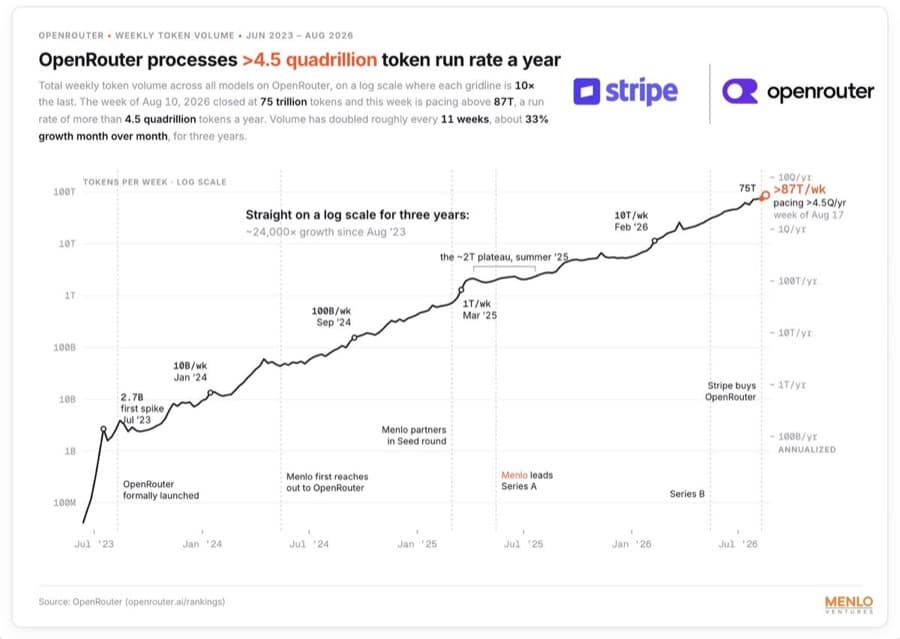
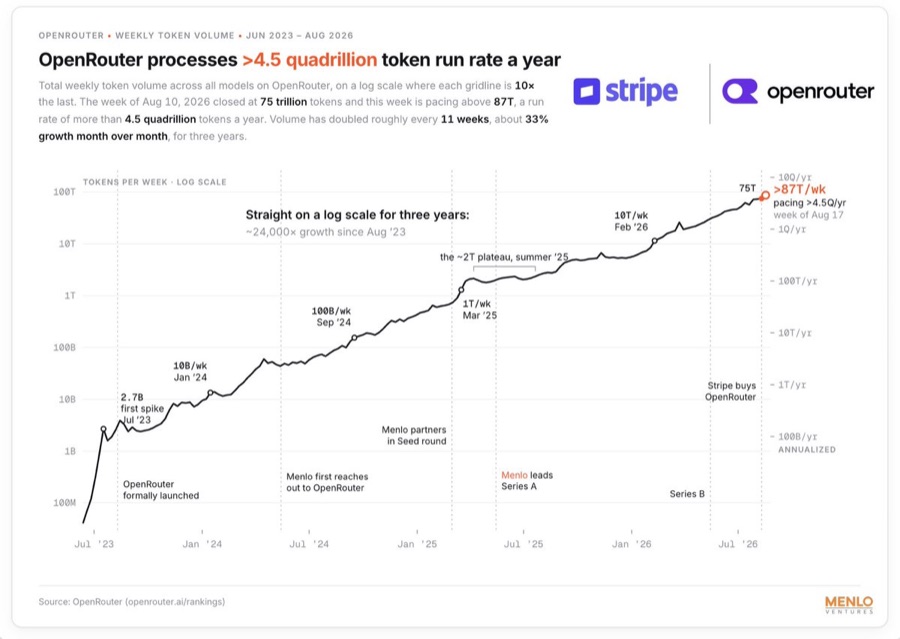
Almost simultaneously with the confirmation, Deedy Das, a partner at OpenRouter's lead investor Menlo Ventures, published a growth graph on X.
It's a chart on a log scale of the weekly token throughput that has passed through OpenRouter since its official launch in July 2023. For all three years, the line climbs almost straight up.
| Period | Weekly token throughput |
|---|---|
| July 2023 (first spike) | 2.7 billion |
| January 2024 | 10 billion |
| September 2024 | 100 billion |
| March 2025 | 1 trillion |
| February 2026 | 10 trillion |
| Week of August 10, 2026 | 75 trillion |
| Week of August 17, 2026 (still being tallied) | 87 trillion+ |
Annualized, that's 4,500 trillion tokens (4.5 quadrillion). That's about 24,000 times August 2023, or an average monthly growth rate of 33% for all three years.
Das cited OpenRouter's own rankings page (openrouter.ai/rankings) as the source. Note, though, that the latest weekly figure (87 trillion) is a preliminary number from before the week closed.
Why did a payments company buy an AI gateway?
In the same post, Das directly rebutted skepticism about OpenRouter. A common criticism is that "OpenRouter has no technical moat."
His rebuttal goes like this: OpenRouter is a two-sided marketplace connecting model providers and users, so its moat comes from scale, not technology. It gives model providers a predictable distribution channel and gives users the simplicity of using many models from one window.
The examples Das cited are specific. Meta (Zuckerberg) and xAI (Musk) both announced new models on OpenRouter first, Chinese models have also launched there first, and OpenAI also ran stealth model releases there, including GPT-5.6 exclusive discounts.
Das quoted Andrej Karpathy as calling OpenRouter "a transfer switch for AI." Stripe, a payments infrastructure company, betting on it can be read as a signal that the model gateway layer is a lasting infrastructure layer, not a passing fad.
The investor drew that graph
However, Das, who published this growth curve, is not a neutral third party. As he said himself, OpenRouter was his "first deal after joining Menlo." He took part in the seed round, and he and his fellow partners led the Series A and joined the board.
According to Menlo Ventures' official profile, Das was promoted to partner in September 2025. With this acquisition locking in Menlo's investment returns, he has an incentive to emphasize the growth, so read it with that in mind.
The acquisition price itself is still undisclosed, which is also why press estimates split between $7 billion and $8 billion. Until the exact figure is official, it's more useful to look at what basis produced this valuation than at the absolute size of the deal.
If your dev team uses OpenRouter for API routing, you'll want to check separately whether pricing or billing integration changes after the acquisition. Stripe hasn't yet published an integration roadmap.