The faster K3.1 Pro Highspeed costs twice as much as the standard version for input, output and cache writes. Cache hits cost the same, and Kimi says Highspeed is about 3x faster while offering the same intelligence and 1 million-token context. The speed advantage may make the choice seem easy, but actual costs depend on usage. Let’s look at the price differences first.
Kimi is here for the coding jobs that run long
Kimi introduced K3.1 Pro as the first model in the K3.1 series. According to the company, it is an open-weight model with 3T-class parameters and a 1 million-token context. It also said it improved not just coding, but 3D creation and financial research.
It is available through Kimi.ai, Kimi Work, Kimi Code and the API. But using it through a service is different from downloading the model weights yourself. Kimi said it will release the full weights on November 4.
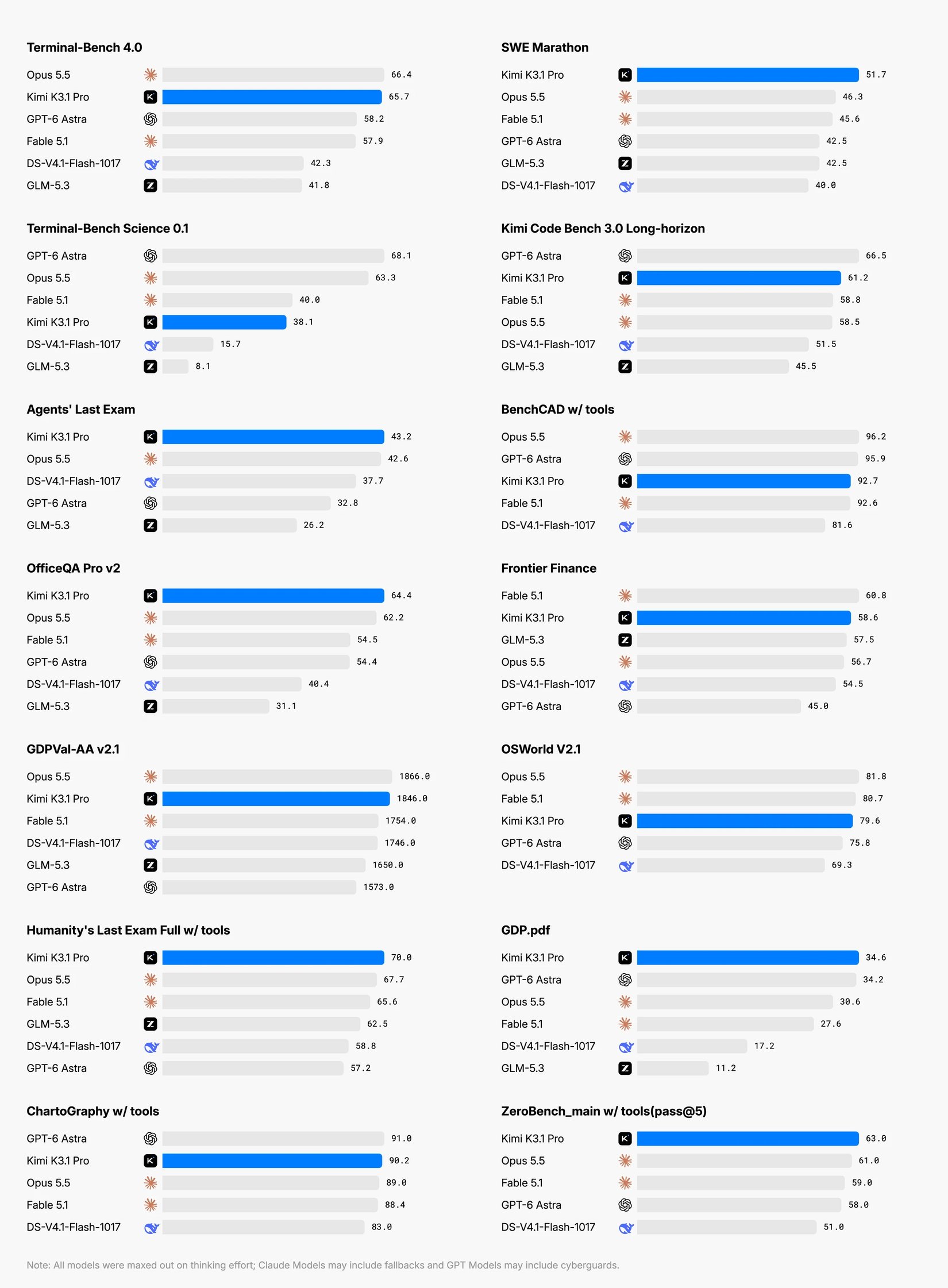
The coding scores are Kimi’s results on Terminal-Bench 4.0.
| Model | Score |
|---|---|
| Kimi K3.1 Pro | 65.7% |
| GPT-6 Astra | 58.2% |
| Claude Opus 5.5 | 66.4% |
In this evaluation, measured by Kimi, K3.1 Pro scores higher than GPT-6 Astra and falls a little short of Claude Opus 5.5. These are Kimi’s measurements, and the scores alone cannot predict results across all coding tasks.
But behind the story of improving performance was also a choice to dial back some capabilities.
They worked on risk, not just scores
Kimi said it observed that vulnerability research capabilities also increased as the scale of post-training grew. Looking into the cause, the company found cyber-related content in general training data and reinforcement learning environments.
Kimi said it identified and removed cyber-related data in both training stages while preserving general coding tasks. It described this as a measure to reduce potential misuse risks while retaining the model’s general usefulness.
On Kimi’s internal xdev-bench-hard evaluation, the checkpoint without these measures scored 90.5% on pass@3, while the final K3.1 Pro scored 81.0%. The difference between the two figures Kimi reported is 9.5 percentage points. That is a difference on this internal evaluation, not a claim that real-world misuse risk fell by the same proportion.
The fact that performance improvements and risk reduction took place together is another part of this announcement. Still, numbers from an internal evaluation do not stand in for every real-world use environment.
They also reported gains on long-running tasks
Kimi said K3.1 Pro scored 61.2% on its own long-term coding evaluation, Kimi Code Bench 3.0 Long-horizon. That is higher than the previous model K3’s 55.95%. The company says the evaluation looks at multi-step execution, tool use and problem solving.
The company blog also describes a walking simulator example. Kimi said it improved walking in the simulation after 167 missions and 420 independent reviews, reaching 11.2 seconds of continuous walking. It added that instead of repeatedly adjusting reward settings, it found and fixed 36 errors in the calculation of shoulder muscle moment arms.
There are limits to the factuality evaluation figures, too. On Kimi’s internal, challenging factuality stress test, the claim-level hallucination rate reportedly fell from 23.4% for K3 to 8.3% for K3.1 Pro. The company said the test deliberately included questions likely to produce errors, and does not represent the overall error rate in everyday use.
The faster version costs more, too
Token prices on the Kimi API platform differ between the standard model and Highspeed. MTok means 1 million tokens.
| Model | Input | Output | Cache write | Cache hit |
|---|---|---|---|---|
| K3.1 Pro | $2.00/MTok | $10.00/MTok | $2.00/MTok | $0.20/MTok |
| K3.1 Pro Highspeed | $4.00/MTok | $20.00/MTok | $4.00/MTok | $0.20/MTok |
So Highspeed costs twice as much as the standard model not only for input and output, but also for cache writes. Only cache hits cost the same.
Kimi says Highspeed is about 3x faster while offering the same intelligence and 1 million-token context as the standard model. If you use 1MTok each for input and output, the cost excluding cache is $12 for the standard model and $24 for Highspeed.
It is worth considering whether a task really needs a fast response, and whether the benefit of reducing wait time outweighs the difference in token costs. The price difference applies to both input and output, while cache hit prices are the same.

Beyond code, it can work with 3D models
Kimi says K3.1 Pro can work with game engines such as Unity, Unreal Engine and Godot, and create results using web search and 3D generation. It also said it improved composition, typography, animation and polish in web pages, Three.js scenes and 3D assets.
In the BenchCAD 3D reconstruction evaluation announced by Kimi, scores with tool use were 92.7% for K3.1 Pro, 96.2% for Claude Opus 5.5 and 95.9% for GPT-6 Astra. Kimi says it can write and run scripts for Blender and CAD software without an MCP connection.
Still, it is hard to judge the quality of real work from the model’s description alone. If you are working with design files, checking the results yourself should also be part of the workflow.
The weight release is the next milestone
K3.1 Pro is already available through Kimi services and the API, while releasing the full weights is a separate step. Kimi’s stated release date is November 4. So calling the model through the API now is different from downloading the weights and running them yourself.
Kimi said K3.1 Pro scored 81.0% on its internal vulnerability evaluation after risk mitigation measures. This figure does not prove the model is safe. It is the result of Kimi’s own evaluation of its effort to reduce potential misuse risks during training.
If you use 1MTok each for input and output, the standard model costs $12 and Highspeed costs $24. Kimi’s stated date for releasing the full weights is November 4. Using the model through a service or API is different from downloading and running the weights yourself.
Official sources
· Kimi K3.1 Pro technical blog
· Kimi API platform
· Kimi Code official documentation