Anthropic announced it on its official blog on August 18, 2026: Claude autonomously designed protein binders.
Its official X account shared the news in a thread at 7:30 a.m. KST on August 19. It runs from the first tweet to the tweet with the key figures.
Claude's 22-35% success rate
The models used were Claude Opus 4.8 and the preview model Mythos Preview.
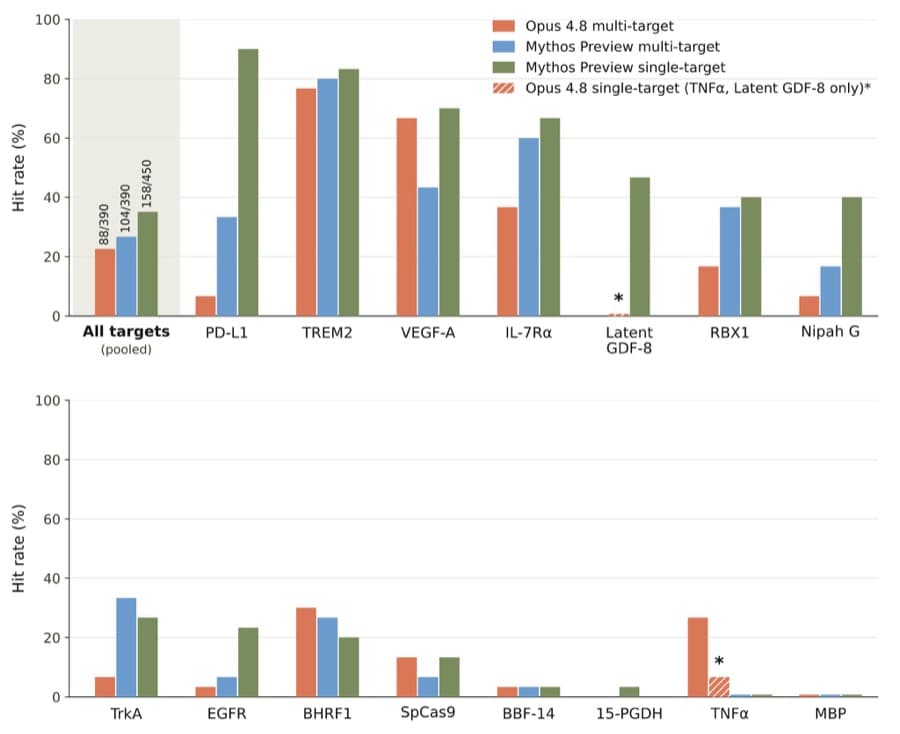
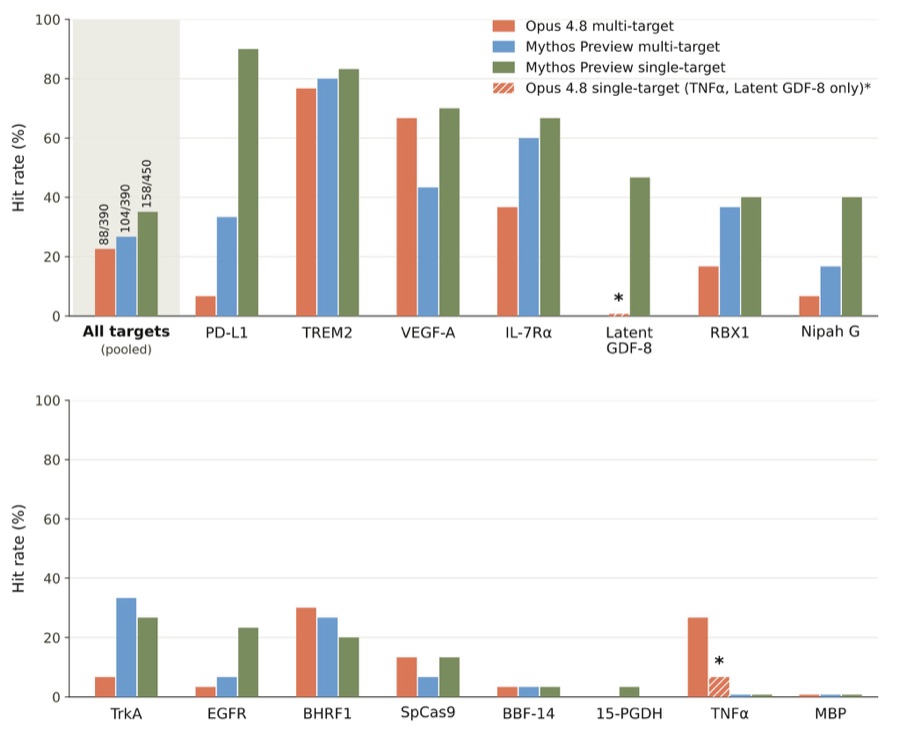
The hit rate was measured across 15 targets and 390 to 450 attempts in total. Opus 4.8 multi-target scored 22.6% (88/390), Mythos Preview multi-target 26.7% (104/390), and single-target 35.1% (158/450). See the original figures
Anthropic summarized this as "between 22% and 35%, depending on the setup."
Claude's gap over the 10-15% industry rate
The typical success rate in pharma is around 10-15%. Claude's 22.6-35.1% is 7 to 20 percentage points higher. Check the official announcement
However, repeat reproducibility has not yet gone through peer review. That's something to keep watching.
| Setup | Success rate | Attempts |
|---|---|---|
| Opus 4.8 · multi-target | 22.6% | 88/390 |
| Mythos · multi-target | 26.7% | 104/390 |
| Mythos · single-target | 35.1% | 158/450 |
Claude succeeded on 14 of 15 targets
It succeeded in designing binders for 14 of the 15 targets, including PD-L1, TREM2, VEGF-A, IL-7Rα, Latent GDF-8, RBX1, Nipah G, TrkA, EGFR, BHRF1, SpCas9, BBF-14, 15-PGDH, TNFα, and MBP. Check the technical report
Of these, high-affinity binders emerged for at least six targets. For at least four targets, the results matched or exceeded the best previously published records.
Binders, not drugs: what's next
Anthropic drew the line itself. It stated "protein binders are not drugs."
Designing a high-affinity binder is only the first step in developing a drug-like molecule. Many steps remain to prove safety and efficacy.
So this announcement shouldn't be read as "AI made a new drug." What to watch for is follow-up validation and whether it passes clinical stages.
Life sciences access starts with Opus 5
Anthropic said that launching an access program for scientists to its top-tier models is a top priority, with more news to come soon.
It stated that the strongest model for life sciences research is currently Opus 5. The technical report and dataset have also been released. If you're a researcher, start with the originals.