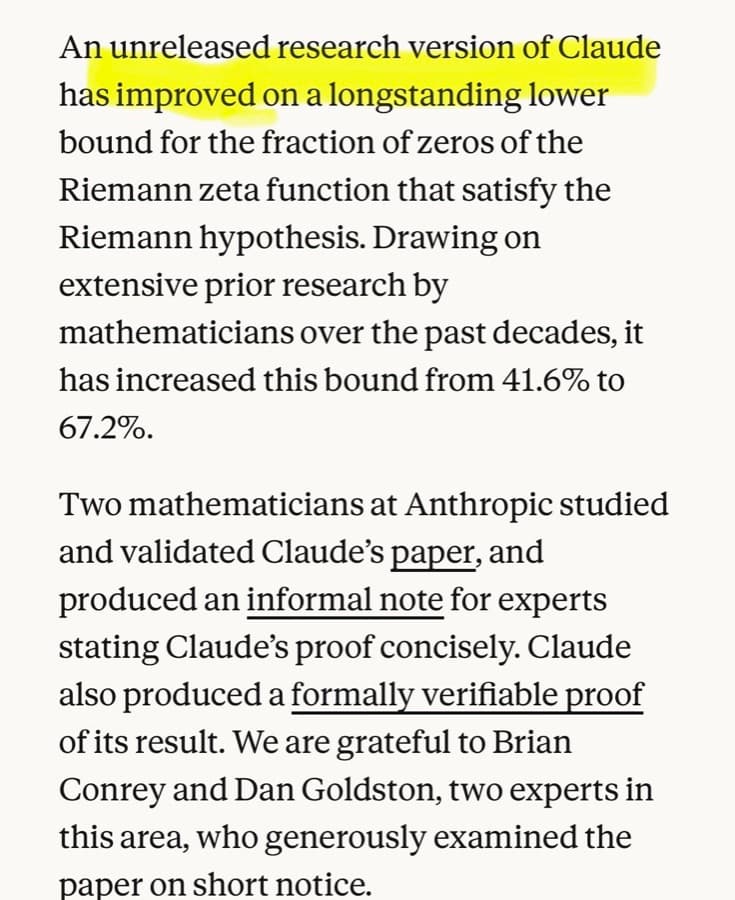
On August 10, Anthropic published an interesting result through its official research page and its X account. It had given an unreleased research version of Claude one of mathematics' biggest open problems, the Riemann Hypothesis. To start with the outcome, it did not prove the hypothesis itself. It did, however, push a bound in a related subproblem that had stalled for more than 160 years by the largest margin ever. The news spread to more than 140,000 views through researcher Chubby's (@kimmonismus) summary thread, drawing even reactions like "the first case of AI working like a mathematician."
What It Did: From 41.6% to 67.2%
The Riemann Hypothesis is the statement that "all the zeros of the zeta function lie on the critical line," a Millennium Problem nobody has been able to prove since it was posed in 1859. What Claude worked on wasn't the whole hypothesis but a subproblem: "a lower bound on the proportion of zeta function zeros that actually satisfy this condition." After decades of mathematicians' work, that lower bound had risen to 41.6%, and Claude raised it to 67.2%. Anthropic describes this as "the single largest improvement in the history of this particular bound." If the hypothesis is true, this proportion should theoretically be 100%, so it's important to be clear that it's still far from a proof.
How It Did It: 60 Subagents, Two Days of Computation
The process is interesting too. Anthropic employee Jarred Sumner (not a math major) prompted Claude to "give it a real try" and then left the mathematical judgment entirely to the model. On the first attempt, Claude generated and tried 650 ideas, and all of them failed. When told to try again, Claude coordinated about 60 subagents, running 2,400 shell commands and hundreds of Python scripts over a day and a half, doing thousands of numerical cross-checks against already-known zeta zeros. Across both sessions it used a total of 31 million output tokens. The key insight, Anthropic explains, was an approach that "treats zeros on and off the critical line not separately but as a single unified geometric space."
Why You Can't Just Wave It Off: Lean Formal Verification
As if responding to the worry that AI-produced mathematical claims are hard to take at face value, Anthropic put the verification stage in two layers. First, mathematicians Brian Conrey and Dan Goldston, real experts in Riemann Hypothesis research, reviewed Claude's paper, and two Anthropic mathematicians separately rechecked the result and wrote an expert summary note. In addition, Claude also produced its result as a formally verifiable proof in the Lean language, meaning a form in which a computer can mechanically check for logical errors without a person reading it line by line. This Lean proof has been made public.
The 60 Agents Behind 67.2%
There are three points not to exaggerate. First, this result is not a paper that has formally passed peer review. It has been reviewed by two experts but hasn't gone through a journal review process. Second, Anthropic hasn't said specifically which model it used, so it's hard to reproduce the same thing from start to finish from outside. Third, it's an improvement on a subproblem that still leaves a large gap to a proof of the Riemann Hypothesis itself. Still, from the standpoint of agent orchestration it's worth noting: the process of coordinating 60 subagents for nearly two days and narrowing the problem through repeated failures reads as an operating example for deploying coding agents on complex research tasks.