A tweet posted by X account @Hesamation in the early hours of August 21 (KST) spread, drawing more than 170,000 views. It said, "AT&T is running 40% of employee AI usage on open models and plans to raise it to 60-70%" and "coding costs down 56%, quality drop only 2%, 45 billion tokens processed a day."
45 billion tokens a day: AT&T's open-model bet
These figures aren't just one tweet's claim. PYMNTS and AT&T's official blog cross-confirm the 56% coding cost reduction, the 2% quality drop, and the goal of raising open-model share from 40% to 60-70%. The 45-billion-tokens-a-day throughput is also confirmed by a TelecomLead report. The original source is the Applied AI newsletter from the paid outlet The Information, titled "AT&T is Using Open Source Models to Curb Anthropic Bills."
| Metric | Figure |
|---|---|
| Share routed to open models | 40% → target 60-70% |
| Change in coding costs | -56% |
| Quality drop | -2% |
| Daily token throughput | About 45 billion tokens |
The "AI chief" remark was actually someone else
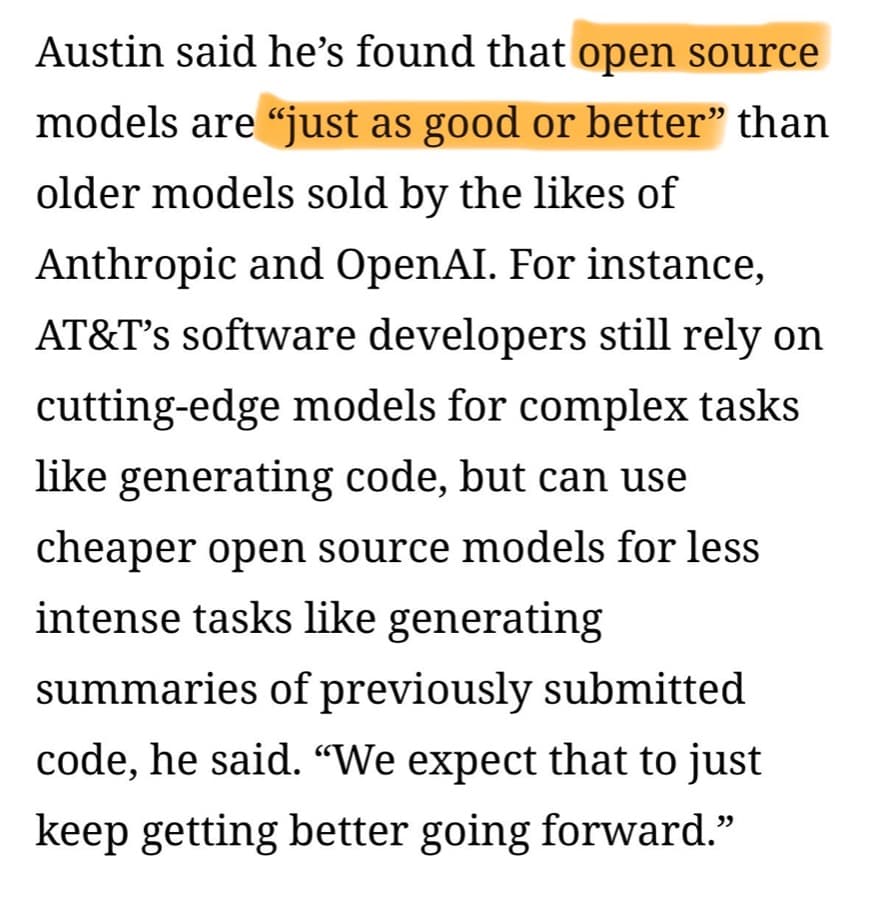
The viral tweet attributed the statement that "open models are just as good or better for many tasks" to the "AT&T AI chief." But opening the screenshot actually attached to that tweet, the speaker is Mark Austin (VP, Data Science). AT&T's official Chief Data and AI Officer is a different person, Andy Markus. The words of two people with different titles got lumped together into one tweet line.
Code generation is still for frontier models
AT&T hasn't switched entirely to open models. It's a two-track strategy: it still uses frontier models from Anthropic and OpenAI for complex tasks such as code generation, and moves only relatively lighter tasks such as code summarization to open models like Nvidia Nemotron, Meta Llama, and Google Gemma. It also uses OTel 2.0, its own fine-tuned version of Google Gemma 3 31B-IT, and the DeepSeek and Moonshot families are only being evaluated and haven't been adopted yet. For companies designing their AI cost structure, this approach of splitting by task difficulty, rather than "all open models" or "all frontier models," is worth referencing.