Knowing a lot of AI tools isn't enough.
You have to decide what to build, how to verify it, and how far to delegate.
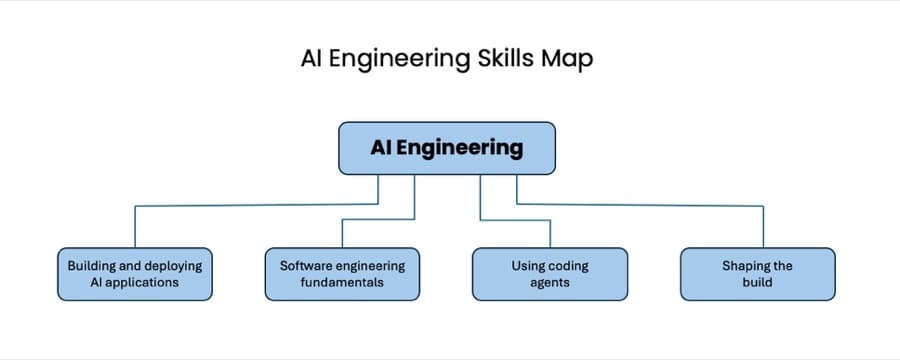
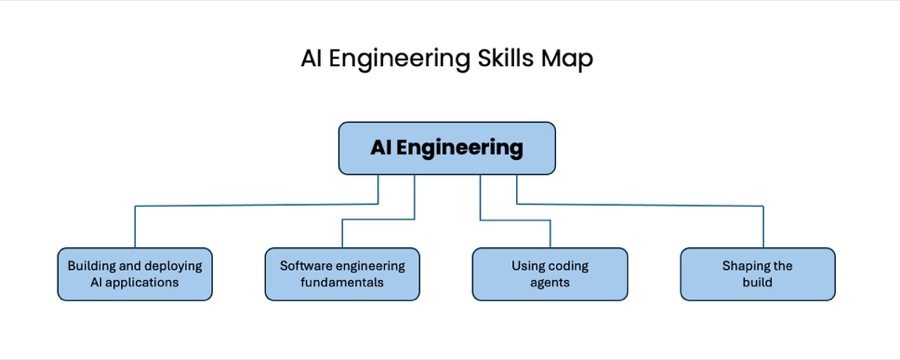
On August 15, 2026, Andrew Ng released the AI Engineering Skills Map.
It's a map based on more than 10,000 job postings and expert interviews.
First, Build and Run AI Applications
AI apps are different from traditional software.
The same input can produce different output.
So attaching a model is not the end of it.
You need to understand context engineering, retrieval-augmented generation, and agent workflows.
Above all, you need evaluation and error analysis.
Second, Have the Software Engineering Fundamentals
Even when a coding agent writes the code, people make the choices.
You have to compare cost, scalability, reliability, and speed.
Security and privacy also need to be handled at the design stage.
Without fundamentals, it's hard to read the tradeoffs in what an agent produced.
What you need before a good prompt is good judgment about structure.
Third, Work With Coding Agents
Knowing an agent's limits is where you start.
You manage context and adjust how much weight goes to planning versus execution.
You attach verifiers so the agent closes the loop.
When coordinating multiple agents, you also need to divide work boundaries and permissions.
Fourth, Decide What to Build
With a clear spec, agents implement quickly.
So the human role shifts from pixel-level implementation to problem definition.
You have to understand customer goals and business context and decide what goes into the spec.
This is what Andrew Ng calls shaping the build.
Order: Deploy, Evaluate, Agents, Product
First, ship a small AI feature.
Then build evaluation metrics and failure logs.
Check structure with software fundamentals, and cut repetitive work with coding agents.
Finally, define customer problems and product specs yourself.
This map will outlast any list of specific tools.
Even when tools change, the ability to verify and set direction remains.