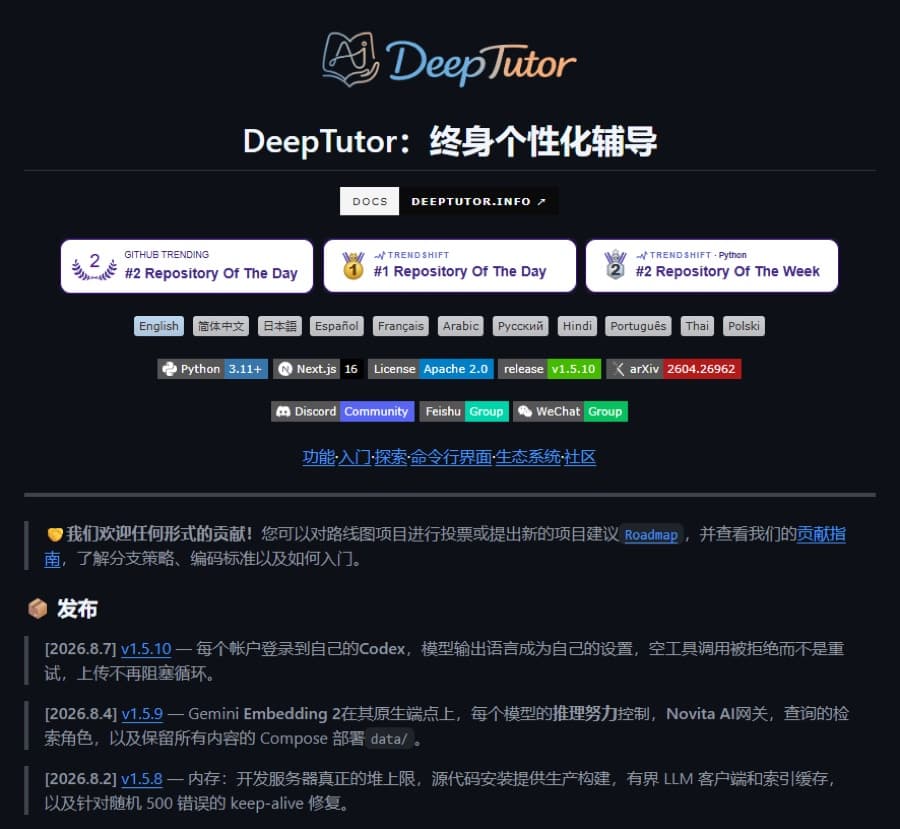
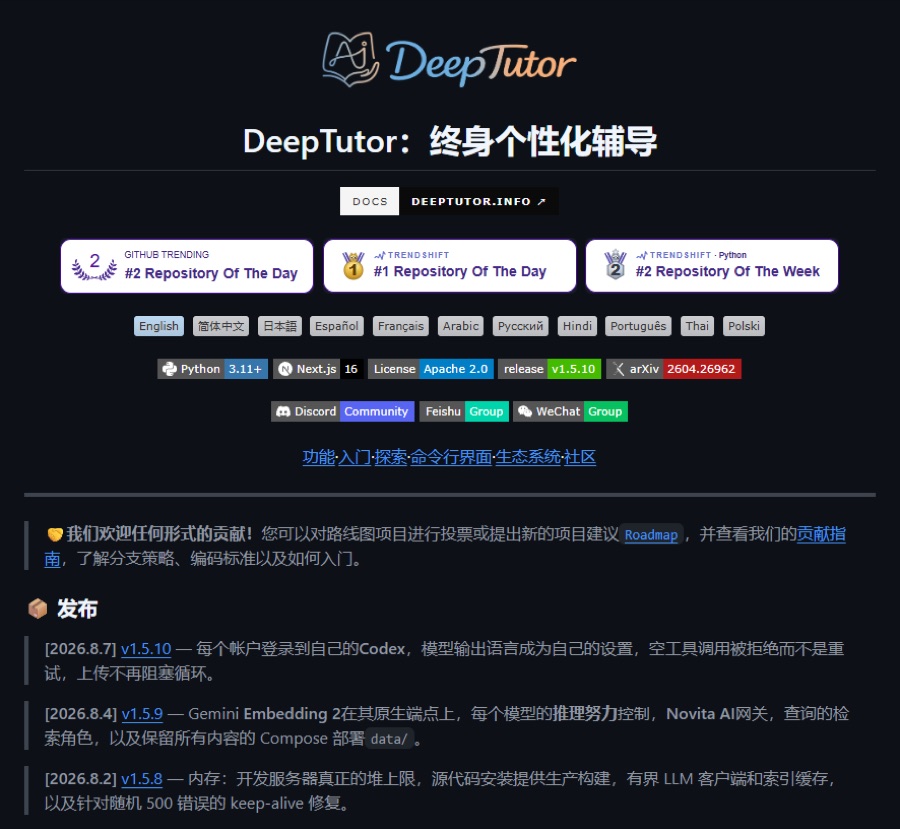
A post that passed 59,000 views in the Chinese-language developer community quietly put an open-source project back in the spotlight. User LanfAI (@Huahuazo) left a hands-on review to the effect of: "I didn't expect it to be stronger than a general-purpose AI, but when I put in papers and notes, it was completely different. It's not like existing question-and-answer chatbots." The project he mentioned is DeepTutor, an open-source "agent-native" personalized tutoring system built by the Data Science Lab at the University of Hong Kong (HKUDS).
"I Thought It Was Just a Chatbot": One Review Reignited the Spread
DeepTutor has been a topic since launch just for how fast its star count has grown. But the reason this review drew renewed attention is the number. The original post mentioned "30,000 stars," but when we checked directly through the GitHub API today, August 11, 2026, the HKUDS/DeepTutor repository had 34,026 stars, actually more than the figure in the post. It means the spread didn't stop after the post and is still going.
10,000 in 39 Days, 20,000 in 111 Days: The Pace Actually Picked Up
Looking at DeepTutor's GitHub star trend, the growth curve was steep from the start. It passed 10,000 stars on February 6, 2026, 39 days after launch, and broke 20,000 on April 19, at day 111. The pace didn't slow after that, and by August it had passed 34,000. Hands-on reviews along the lines of "I put in a paper and the chatbot became a tutor" repeatedly acted as the spark for the spread.
| Date | Stars | Time since launch |
|---|---|---|
| 2026-02-06 | 10,000 | 39 days |
| 2026-04-19 | 20,000 | 111 days |
| 2026-08-11 (checked today) | 34,026 | - |
What sets DeepTutor apart from other learning tools is that it unifies several learning modes, such as Chat, Quiz, Research, Visualize, Solve, and Mastery Path, into one agent loop, the same engine. Switching modes doesn't break context, and it keeps following the learner. It also ships with a toolkit including RAG retrieval, code execution, web search, academic paper search, deep reasoning, and brainstorming, so it's closer to a structure that manages a whole learning session than a single question and answer. Related research is public as a preprint on arXiv, and project details are available on the official website deeptutor.info and the GitHub repository.
The Material You Upload Becomes the Curriculum: What Developers and Education Content Creators Should Look At
For developers and education content creators, DeepTutor is interesting because of the structure itself. A general-purpose chatbot Q&A answers whatever you ask from the model's general knowledge. DeepTutor, by contrast, uses the textbooks, papers, and notes the user uploads as source material and tutors within them. That's exactly where LanfAI's review said "completely different." It means you can feed in a particular course textbook, an internal document, or a single research paper and build a learning tool based on only that. And because it's open source, you can host it on your own server or customize the prompts and workflows to match your own curriculum. Education content creators can experiment with a customized study aid by loading a particular subject's textbook, and developers can look at the structure that ties RAG, code execution, and paper search into one loop as a reference architecture for their own products.
34,000 Stars Don't Guarantee Answer Quality
But the speed of spread and actual quality are separate matters. GitHub star counts are only an indicator of interest and popularity, not a measure that verifies answer accuracy or tutoring quality. It's also worth remembering that the starting point of this spread wasn't a benchmark or third-party evaluation but one subjective hands-on review in an X post in the Chinese-language community. If you're considering adopting it, rather than judging by star count, the first step is to load the textbook or documents you actually plan to use and check the accuracy of the output and how it cites its sources.