
Six Machines on Desks, and Why It Doesn't Stop When the Internet Goes Down
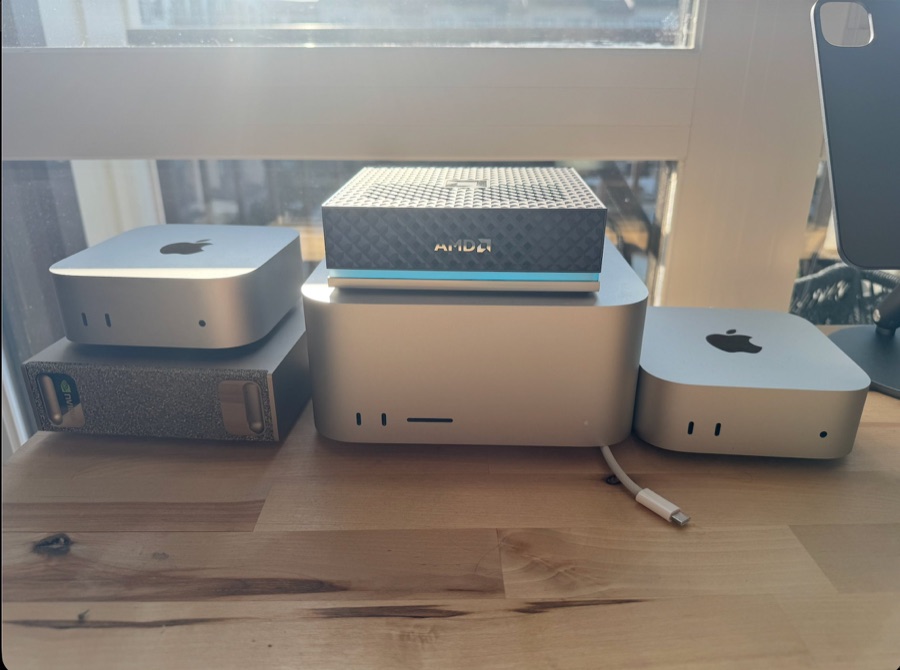
X user Alex Finn (@AlexFinn), who is active posting about AI, shared an eye-catching work setup in his post. He said that on his desk and another desk sit a DGX Spark, an AMD Halo, three Mac Studios, and two Mac minis, and that these machines run a "Hermes" agent driven locally by the Qwen 3.6 model 24 hours a day, 365 days a year. The line "I don't care if the internet goes down" stands out for emphasizing an automation pipeline that keeps going even offline.
Why Are Developers Turning Away from Cloud APIs?
Behind the attention to this kind of "local agent homelab" setup are shared complaints. The first is accumulating cloud API costs. Running agents around the clock makes token usage climb fast, and over the long run the math says investing in local inference hardware is more economical. The second is the privacy benefit of not having to send sensitive code or data to outside servers, and the third is stability that doesn't depend on network failures or API downtime. A setup that runs regardless of internet connectivity, like this one, reads as an attempt to solve all three complaints at once.
What Studios Can Learn, and the Realities to Get Past
For a development studio or team, the direction itself of delegating repetitive work to local agents is worth noting. But upfront hardware investment, power and heat management, and maintenance burdens like model updates and failure response are separate problems. Running several Mac Studio or DGX Spark-class machines is by no means cheap, and how many people's worth of work this setup actually replaces, and how reliably it runs 24/7, isn't specifically confirmed in the original post.
| Equipment | Quantity | Role (per his own description) |
|---|---|---|
| DGX Spark | 1 | Local inference |
| AMD Halo | 1 | Local inference |
| Mac Studio | 3 | Running the Hermes agent |
| Mac mini | 2 | Running the Hermes agent |
A 24-Hour Homelab, Success Rate Unverified
This post drew attention with 80,000 views and 1,300 likes, but it's only a first-person statement from his own account. There's no third-party verification backing actual task throughput, agent success rate, or the stability of 24/7 operation. Studio Huuush presents it not as a verified benchmark but as an example showing the trend of local AI agent homelabs, and leaves reproducibility and real cost-to-efficiency as separate questions to weigh.