You Use Claude Code and Codex Together. Do You Know What You Spent This Month?
Few developers use just one coding agent anymore. Some tasks go to Claude Code, others to Codex, and refactoring gets handed to Cursor, so switching tools has become routine. The problem is that once your usage is scattered like this, you can't see at a glance what this month's API bill really is. You had to open each tool's dashboard separately and add up the tokens just to get a rough idea.
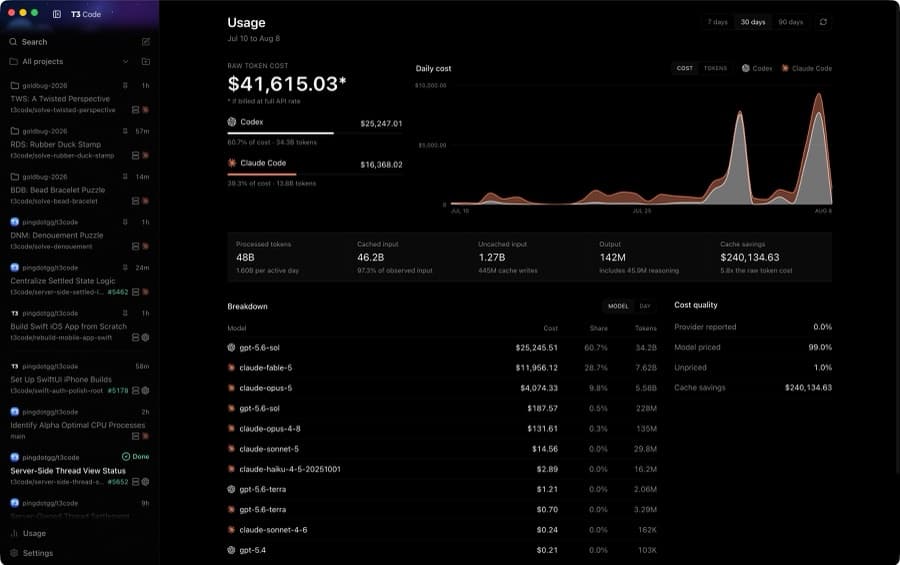
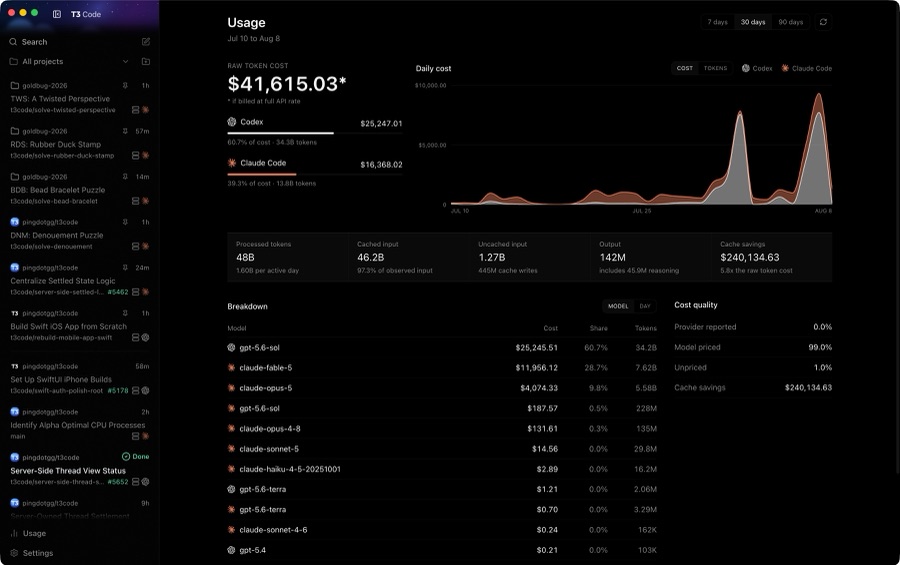
A new feature aims squarely at that gap. Theo Browne, who built T3 Code (a developer YouTuber and the t3.gg operator known as @theo), released a new "usage" page. According to his X post, the page analyzes API costs and token usage across Claude Code and Codex on one screen. The post drew 130,000 views and 1,300 likes.
Not Just a Tally: It Reads the Real Usage History Left on Your Machine
The key to the usage page is how it aggregates. According to what was released, it doesn't count only T3 Code's own usage. It builds its totals from the actual Claude and Codex usage history stored on your local machine. That means it reflects all the real usage data piled up across multiple devices. Whether you launch Claude Code directly in a terminal or run the Codex CLI on its own, if the trace is on your machine, the usage page reads it and shows it as one picture.
This matters because you don't need to hook anything up or add any settings. T3 Code finds and reads the usage history already sitting on your machine, so there's no new account to create and no separate API to call. One caveat: the feature is currently available only in Nightly builds.
No Account, No Subscription Fee: You Use What You Already Have
The question people new to T3 Code get stuck on is, "So what does it cost?" The answer is simple. T3 Code is open source (MIT license), and as the official FAQ states, there's no paid plan, no subscription, and no account creation. Instead it uses a "Bring Your Own Subscription/Key" model: you connect the OpenAI, Anthropic, or Cursor subscriptions and API keys you already have. T3 Code doesn't add a markup in the middle. It recognizes what you already pay each service and handles only the orchestration.
That structure lets T3 Code orchestrate several coding agents from one interface, as the table below shows.
| Agent | Provider | How it connects |
|---|---|---|
| Claude Code | Anthropic | Existing subscription/API key |
| Codex | OpenAI | Existing subscription/API key |
| OpenCode | Open source | API key |
| Cursor | Cursor | Existing subscription |
| Grok | xAI | API key |
Seen this way, T3 Code isn't selling a new AI service. It pulls together the subscriptions and keys developers already scatter across tools, and makes it visible how much, and how, you're using your tools. The usage page extends that philosophy. Better Stack's T3 Code overview also describes the project's identity as an orchestration layer that isn't tied to any one vendor.
In practice the benefit is clear. If you run several agents side by side, you no longer need to dig through multiple monthly bills and add them up. You can check your entire coding-agent spend for the month on one screen. For teams trying out several tools, just knowing which agent the costs are piling up on gives you a basis for choosing tools.
T3 Usage: Nightly Only?
Some things still need confirming. This usage page is available only in Nightly builds, not in the official (stable) release, and the public material doesn't say when it will be merged into a stable version. There also aren't verified user reviews beyond the original post and the official docs on the exact screen layout, aggregation accuracy, or how often data syncs between devices. If you're considering adopting it, expect the instability typical of Nightly builds and test it on a small scale first.