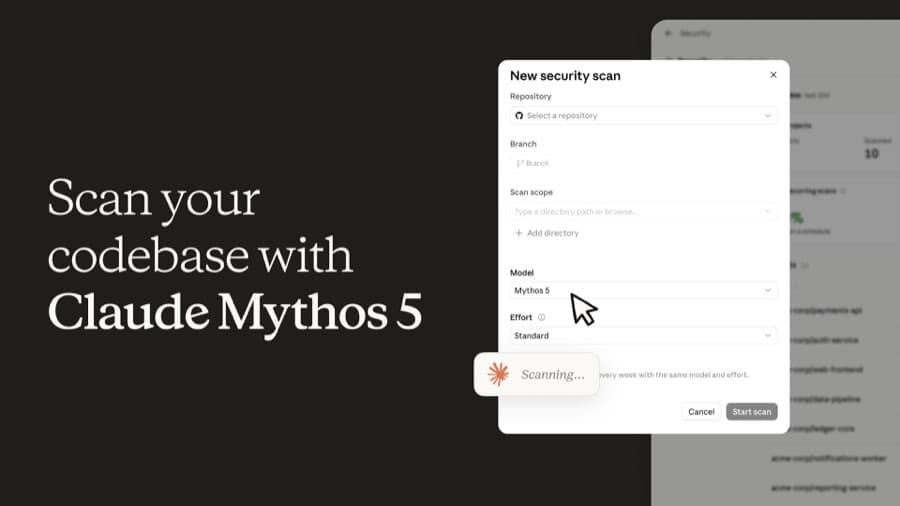
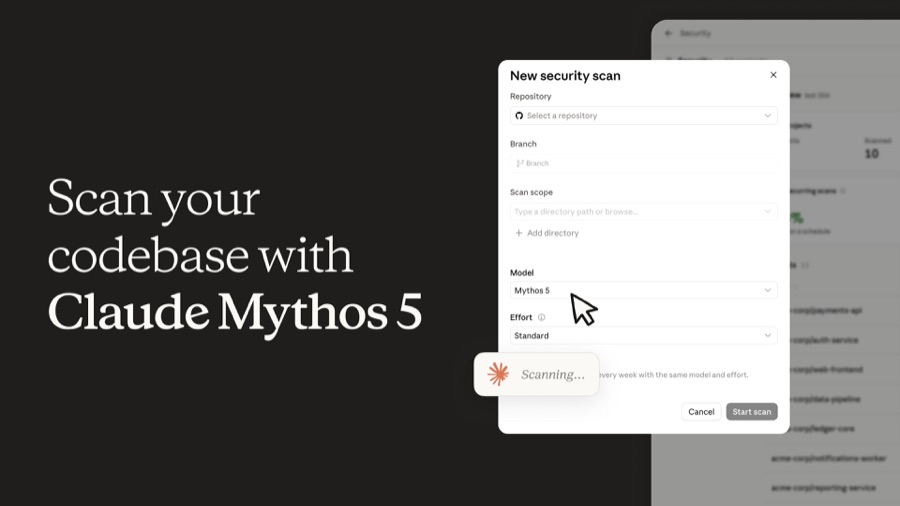
Anthropic announced from its official account (@claudeai) at 2:23 a.m. KST on August 22, 2026 that Claude Security Scan now runs on Claude Mythos 5. It is open as a public beta to all Claude Enterprise customers and can be used right away without separate model access.
Just pick a repository
Using it is simple. Once an Enterprise admin turns on Claude Security in the admin console, team members just pick a GitHub repository at claude.ai/security. Mythos 5 reasons about data flow across whole files and interactions between components to find vulnerabilities (Anthropic's official blog).
Issues it finds come back with the following information.
| Item | Details |
|---|---|
| CWE category | Vulnerability type classification based on Common Weakness Enumeration |
| Confidence rating | Reliability of the detection result |
| Severity rating | Severity of the issue |
| Suggested patch | Can be opened directly in Claude Code on the web for review |
Patches are not applied automatically. A person has to review and approve them before they go into the code.
Same pricing, different access
Mythos 5 scans are not a separate add-on. They're billed at the standard token usage of your existing plan. Users don't send prompts to the model directly. Mythos 5 runs behind the scan job and only the results come back, which Anthropic ties to its safety principle that "risk grows when users have direct access to the model."
This release is also a step in widening Project Glasswing, which gave only a small number of organizations access to the top-tier model, to more defenders. Anthropic also announced a $35 million Defender Advantage Fund to support open-source security. It covers real-time patching of popular projects, automated scanning and patching that other projects can copy as is, and more ambitious defensive research that stops entire classes of attacks.
Is it really Mythos 5?
Reactions right after the announcement were mostly positive, but some users doubted whether "this is really Mythos 5, or just Opus 5 with a new name." Anthropic did not respond to this separately, and the announcement had no official figures backing actual detection accuracy or false-positive rate. If your team is trying it for the first time, the safer approach is to enable the feature in the admin console, run a pilot scan on a small repository, and check the results yourself.