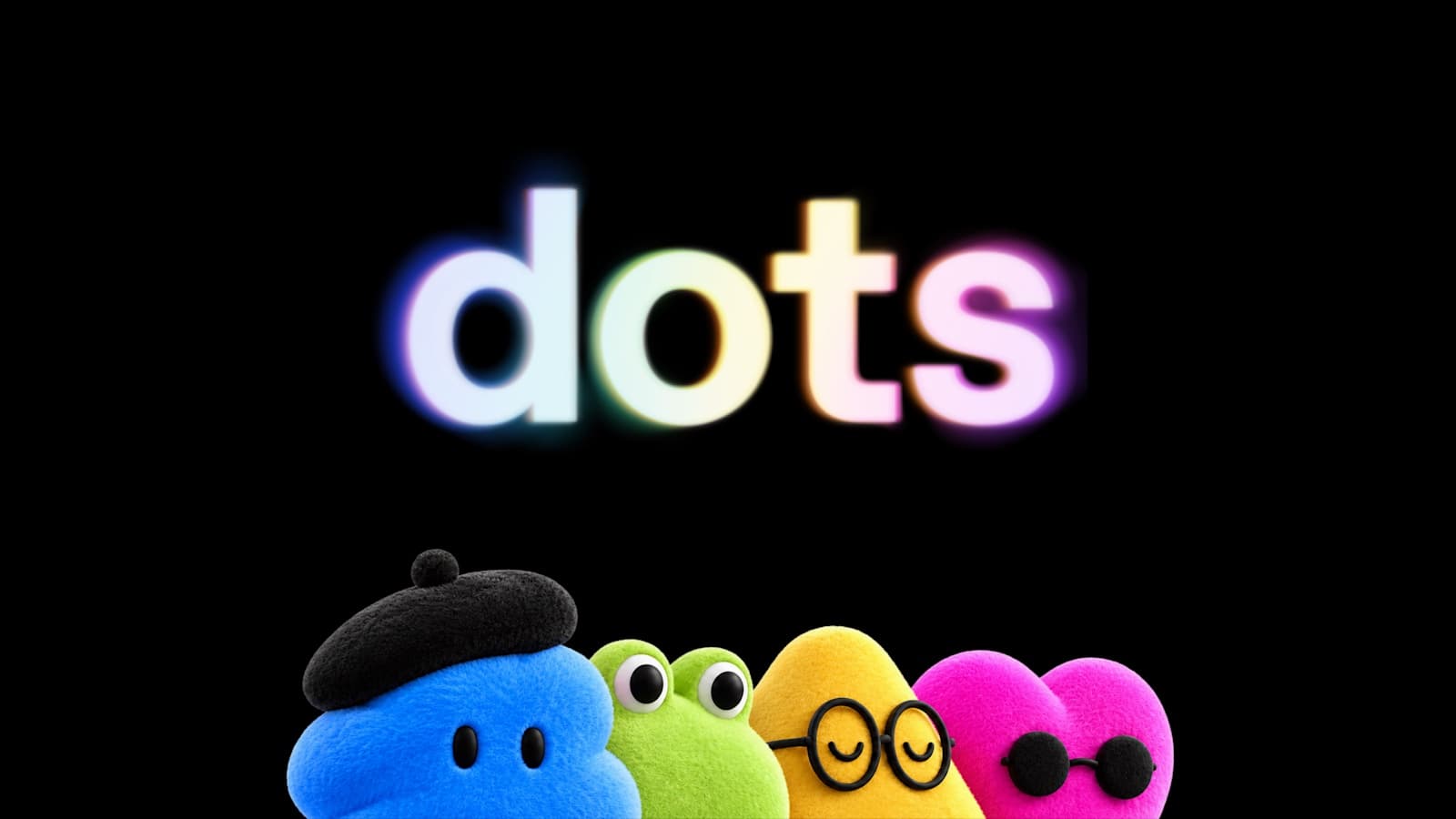
Source: OpenAI
OpenAI unveiled dots at DevDay on September 29 (US time). It is a ChatGPT agent where, once you set a goal and permissions, each dot keeps working on its own assigned cloud computer even after the conversation ends. The memory, screen understanding, and cloud execution threads that began with last year's Pulse have come together in one product. The next competition may move beyond models to who provides the computer an agent lives on.
Source: X @OpenAI
What OpenAI dots is: give it a name, goal, and permissions, and it works on its own computer
You name your first dot and set its goal, success criteria, and access permissions. Built on GPT-6 Astra, dots uses more than 4,000 connected apps from each dot's own cloud computer and browser, and hands work off to ChatGPT Work or Codex. It runs several projects in parallel, keeps going even if you close the conversation, and brings back results and options at the moments that need your judgment. ChatGPT memory and connected apps serve as its working context.
You can call a dot through ChatGPT chat on web, desktop, and mobile, and by voice call. Text messages, Slack, and Teams are also supported, and mobile messaging must be set up on desktop first. A waitlist is open for iMessage and RCS for Pro users.
| Availability | Details |
|---|---|
| Individuals and teams | Rolling out starting with Pro and Business Premium in supported regions. Pro excluded in the EEA, Switzerland, and the UK |
| Enterprises and institutions | Admins enable the beta for Enterprise, Edu, and Healthcare |
| Usage | No added cost for your first dot. Conversations with a dot are excluded from ChatGPT limits, while Codex and Work tasks use those limits |
| Early expansion | Expanded deep-work limits for the first month after launch (through October 29, 2026) |
In Korea time, Tibo Sottiaux's announcement came at 2:16 AM on September 30, followed by OpenAIDevs at 2:40 AM and Sam Altman at 3:01 AM.
Source: X @thsottiaux
Source: X @sama
A layer on top of Codex and ChatGPT Work
dots is a personal agent that remembers how you showed it to do something once and proposes it first when a similar situation comes up. In the development example OpenAI gave, it gathers and sorts bugs and feature requests piled up in connected apps, scopes them by priority, then has Codex implement and test the code and open a PR. Internally it is used for investigating Slack bug reports, turning new designs into working apps, and managing planning cycles. An early tester's dot prepared a forgotten invoice and sent it after getting approval.
If a scheduled task is closer to a job that repeats at a set time, a dot picks up the context and chooses the next job to match its goal.
Source: X @OpenAIDevs
Source: X @OpenAIDevs
The morning focus time Sam Altman won back with dots
In an Every interview, Sam Altman explained that a dot helps him protect his creative morning focus by picking out and flagging only the urgent things that happened overnight. He described building a personal work dashboard that keeps updating with context from Slack, and a method of having it produce several feature mockups from idea notes and refining them with his feedback. This is Altman's personal use case. You can see it in the Every interview intro and the full transcript (07:40–16:00).
OpenAI explains that dots can do proactive research in the background using the context of the apps you connect. That research is read-only, and the user sets action permissions and approvals. You can see the features and permission scope in the OpenAI dots introduction.
The first signal was last September's Pulse
ChatGPT Pulse, released on September 25, 2025, researched overnight based on your conversations, memory, and connected apps and delivered personalized cards in the morning. The next month, OpenAI acquired the Sky team, which builds software that understands the Mac screen and operates apps. When it shut down Pulse on June 17, 2026, it moved some of the proactive updates to Scheduled Tasks. With Pulse it secured the ability to speak first, and with Sky the ability to operate a computer directly. Looking back, shutting down Pulse in June was closer to clearing the way for dots. Pulse, which stopped at handing over information, gained an execution environment and became an AI that moves first.
At the time, the once-a-day briefing, screen understanding, and scheduled execution looked like separate features. In dots, they are bundled into an agent that keeps collecting context and doing work.
ChatGPT Pulse intro · Sky team announcement · ChatGPT release notes
Features to see, remember, and organize came one after another
The Codex Chronicle experiment on April 21 built memories from screen context and let users review and edit them. The Dreaming memory announced on June 5 merges scattered context and updates memories even after a conversation ends, borrowing the way people sort out memories while they sleep. Computer History, released on August 14, shows activity in the apps and on the web you allow in chronological order, and it is a feature that continues from Chronicle. dots understands the user on top of this structure of watching during the day and sorting memories during downtime.
This thread runs toward recording what it saw, leaving behind the memories needed in the next conversation, and applying them to later work.
Source: X @OpenAIDevs
Source: X @OpenAI
Source: X @OpenAI
Source: X @OpenAIDevs
Source: X @OpenAI
The third era Altman foreshadowed
At Dreamforce on September 15, Marc Benioff and Sam Altman described changes in AI in three stages. The first stage is chatbots that answer questions, the second, which began to be widely used this year, is coding and computer-use agents, and the third is a stage where AI is always running for the user. If agents understand the work, check Slack and email first, and move in the background, Altman thought the way people work could change significantly by the end of this year. dots is the first product of that third era.
Source: YouTube Salesforce
The next models need more than a laptop
Tibo Sottiaux, who leads Codex at OpenAI, wrote on August 4, "The next generation of models will need more than a laptop." It reads as saying better models alone are not enough, and that you need an environment that can run for a long time and a foundation to coordinate many tasks.
In June, OpenAI acquired Ona to fold cloud execution and orchestration into Codex and to support work that persists across sessions. The Astral acquisition adds the uv, Ruff, and ty developer tools, Promptfoo adds agent security evaluation, and Statsig adds experimentation and feature flags. That puts the loop of execution, verification, and feedback together. The cloud computer assigned to each dot is the finished form these acquisitions were heading toward.
Source: X @thsottiaux
Ona acquisition announcement · Astral acquisition announcement · Promptfoo acquisition announcement · Statsig acquisition announcement
It moves between a cloud computer and your computer
A dot works on its own cloud computer by default. If you grant separate permission, it can connect to a personal device such as a laptop and handle local files and code, and you can open the cloud computer at any time to watch the work. As more sites block agent access, a personal computer can become a doorway that enters under the user's identity.
When Apple announced the M6 Mac mini on August 25, it emphasized always-on agent computing. Perplexity's Portable Computer presented a setup that runs models and the runtime on a local device like the DGX Spark and scales larger jobs out to the cloud.
Apple M6 Mac mini announcement · Perplexity Portable Computer
One computer per agent, a shared industry design
Giving each agent a persistent runtime environment shows up at several companies. SpaceXAI's Grok Bot assigns each bot a cloud computer, browser, file system, and terminal so it keeps working when the user steps away. Meta Muse runs on a dedicated virtual machine for each user. Google Gemini Spark runs 24 hours on Google Cloud even if you close your laptop and connects to Gmail, Docs, and Sheets. Perplexity Computer also coordinates multiple models and tools to carry out compound tasks.
The form, name, and channel differ, but the blueprint is one computer per agent.
Grok Bot · Meta Muse · Gemini Spark · Perplexity Computer
Manus, behind Muse
Manus is a company that showed early on the approach of working with a browser, terminal, and files on a cloud virtual computer for each task. Meta announced an acquisition of about $2 billion in December 2025. According to AP, the Chinese government banned the deal and ordered it unwound on April 27, 2026. Bloomberg Law reported that around June 11, Meta split operations, stopped data sharing, and reversed the acquisition. Manus announced on September 1 that it had resumed independent operations.
Muse's per-user Linux virtual machines, parallel subagent processing, and document and web page outputs resemble the design Manus showed. Meta could look inside that structure for nearly half a year, and I think that experience likely influenced Muse's design.
Meta's Manus acquisition announcement · AP on the Chinese government decision · Bloomberg Law on unwinding the deal · Manus resumes independent operations
The compute one user consumes goes beyond a laptop
When an agent runs all the time, usage does not stay at the tokens of questions and answers. CPU and memory keep the browser, files, and workflow alive, and GPU resources go in every time it reasons. The role of the data center widens from the place where models are trained to the place where agents live and do real work.
If one person runs several agents in parallel, the compute needed can exceed the range of a single laptop. When hundreds of millions of people each have a virtual computer that is on 24 hours a day, the role of the data center changes too. If the last three years were a cycle of GPUs and models, the next cycle could be the computers agents live on.
CPU demand visible in the chip numbers
Intel announced that Q2 2026 data center and AI revenue was $6.3 billion, up 59% from a year earlier. In the 10-Q, the main driver of server revenue growth was a 48% increase in average selling price (ASP). As demand and product mix change together, server CPU revenue is growing too.
On the Q2 earnings call on August 5 (Korea time), AMD CEO Lisa Su said server CPU revenue in the second half would grow more than 80% over the prior year and projected the server CPU market would reach $220 billion by 2030. NVIDIA including the Vera CPU in its Rubin platform points the same way. As agent computers multiply, the role of general-purpose processors that coordinate work around the accelerators grows too. The CPU, long hidden behind the GPU, is coming back up as a key component of the agent era.
Intel Q2 2026 results · Intel 10-Q · AMD Q2 2026 earnings call transcript · NVIDIA Rubin platform
The unit users work with goes up a level
Before, you opened a file, picked an app, and pressed a feature. Now you set a goal and permissions and review the results. The user hands off the request, and the dot moves across many apps and tools to carry it out. Just as companies stopped worrying about infrastructure when they moved from running their own servers to AWS, individuals are heading to a stage where they do not need to know which app runs on which computer. That is also why the default screen of dots is built around an activity log and approval requests. In Activity View you can check progress and adjust direction, and approval requests surface the moments a person has to decide.
The more steps an agent takes on, the more important it is to have an interface that explains what it did and stops when it should.
Screens drawn on the spot instead of apps
In the Dreamforce conversation, Benioff talked about an interface that AI "draws itself in real time" to fit the situation, one that feels "almost alive." Altman named the experience of a model writing 10,000 lines of code to build a new screen as one of the big changes. The idea is that, rather than opening a fixed app and hunting for features, an agent can build the screen that fits your current goal. dots too brings back results as things to review and options to decide on instead of app screens. Apps become parts that supply functions behind the scenes, and the screen the user sees is redrawn for that person each time.
Claudeforce, announced by Salesforce and Anthropic on August 26, lets Claude use Salesforce data, workflows, and business rules. The early Salesforce in Claude plugin offers 37 sales skills. It is a move to connect existing apps' data and permissions to a conversational interface.
Salesforce and Anthropic Claudeforce announcement
The LLM takes the operating system's seat
Managing memory, dividing up work, and controlling app permissions resemble roles operating systems have played. If a dot carries the same memory no matter which entry point you call it from, the agent, more than the app list, can become the default interface between the user and the computer. Once an agent becomes an account with an address, the next stage could be conversations between agents, where a creator's dot and a brand's dot exchange terms directly.
OpenAI presented, as early pilots, a direction where several dots work as a team and specialized enterprise dots with per-organization ID, authentication, and permissions. It also announced work to integrate with the governance and security controls of Microsoft Agent 365.
From apps to phone calls and text messages
On July 2 at 00:33 (Korea time), SpaceXAI released a no-code Voice Agent Builder based on Grok Voice and listed pricing of $0.05 per minute. dots also lets you call a dot from inside ChatGPT to hand off work, from launch. Pro users can also sign up for the iMessage and RCS waitlist. Whether by chat or call, the goal is for memory to carry across even as the touchpoint changes.
Source: X @SpaceXAI
On September 29 (Korea time), Manus released Manus 2.0 and Cue, a personal agent app. 2.0 includes the Cascade agent harness, Cloud Computer and Automations, and Studio. Cue is designed to give a personal agent an email address, phone number, wallet, and computer, and to let it collaborate in group chats. It also presented a flow that starts work automatically when a message arrives by email or Slack.
It becomes possible for a dot to call you first at a moment that needs judgment, ask, "Should I go ahead with the contract on these terms?", pick up the work as soon as it hears your answer, and send the result as a single text when done. App notifications get buried when they pile up, but calls and texts are still the channels that reach a person most surely. The moment an agent has a phone number, a good share of the calls and texts we receive could come from our own agent. It turns from a tool you get contacted through into a colleague that starts work and reports on its own.
Source: X @ManusAI
Source: X @ManusAI
In South Korea, messengers may open first
In South Korea, 010 mobile numbers are tied to a single verified real-name subscriber, so the only number you can realistically attach separately to a personal agent is a 070 internet phone number. 070 numbers are widely used for spam and voice phishing, so carrier spam apps flash a warning first, or many people do not pick up at all. The device meant to block spam ends up making even calls from your own agent to you look like spam.
Messengers are already a familiar channel for work and daily life. ChatGPT has been usable inside KakaoTalk, South Korea's dominant messenger, since October 2025, and can be called in one-on-one chats and group chats. Kakao announced in May 2026 that cumulative sign-ups passed 11 million. A messenger route has to be opened platform by platform and cannot reach anyone directly the way a phone call can. While overseas users' agents call and text first from their own numbers, users in South Korea may use the same dots yet meet the agent only inside app notifications.
Kakao on ChatGPT sign-ups and features
Permissions and oversight for an agent that is on 24 hours a day
According to the WSJ, OpenAI canceled the October launch of GPT-6.1 Astra over safety evaluation problems. Reports cited a failure to meet alignment evaluations, behavior outside the scope of instructions, and failing to properly tell users what it had done. With an always-on agent, such problems can go beyond a single answer and turn into real actions.
dots' default background research only reads connected apps, and it cannot send messages, change app contents, or operate the browser or computer. Users can allow, require approval for, or block actions in Custom Rules. Auto-review checks actions that affect your account or share information against instructions, rules, and safety requirements. Sensitive work like changing a password has to be done by the user.
Meta's Sentinel is isolated on the same machine as Muse and monitors the agent's behavior. On September 28, NVIDIA announced the Open Agent Safety Platform, which controls what an agent can access and do. The trend of productizing persistent runtime environments also demands monitoring and permission control.
WSJ on GPT-6.1 Astra · OpenAI on dots safety and security · Meta Muse safety design
Source: X @nvidia
The remaining piece is the device
At Connect on September 24, Meta announced the handheld Muse Charm device with a real-time voice model, and a feature for hands-free use of Muse on AI glasses. Even as the agent stays in a cloud computer, the calling device next to the person is getting smaller and more natural.
According to a Bloomberg report relayed by TechCrunch, OpenAI's first device, made by Jony Ive's io team, is a screenless donut shape with a camera and microphone, targeting a price of $300 to $400 and a 2027 release. On September 14, there was also a report that OpenAI acquired smartphone camera startup Glass Imaging.
Could this donut be the body of dots? The "o" that ran through GPT-4o, o1, and io has reappeared in an agent named for a round dot and a ring-shaped device. With a screenless device, you can hand off goals by voice and just receive results, which overlaps with how dots works. Letting you call dots by phone and text can also be seen as opening an off-screen channel ahead of time. A structure where the donut at home listens, a cloud computer works, and only what needs approval arrives on your phone looks close to the finished form OpenAI is sketching.
Meta Connect 2026 announcements · Report on OpenAI's donut-shaped device · Report on the Glass Imaging acquisition
The scarcest resource becomes human judgment
The more work an agent takes on, the more approval requests there are. What matters is not that a person redoes every step, but asking only when it has to and checking that it keeps to the criteria you set. The next competition looks likely to move, alongside model scores, to how well an agent keeps to the user's criteria while asking as little as possible.
As seen in dots opening first on the higher Pro tiers, users pay a fee for renting a computer that is on 24 hours a day on top of intelligence. OpenAI moves closer to being a cloud provider serving individuals. When to call on human judgment and how to take responsibility for results also become part of the product.
From Pulse to dots
From Pulse's morning briefing, through Chronicle's memory, Computer History's activity context, and Codex's execution environment, dots emerged. Each piece ran in the direction of making an agent remember more about the user, understand screens and apps, and work even after the conversation ends.
Meta, SpaceXAI, Google, and Manus are also attaching a computer to each agent, and agents have begun to get phone numbers and wallets too. Server CPU numbers, personal devices, messenger calls, and approval and monitoring systems all converge on the same question. What people will choose from here is which agent to trust with their memory and their computer.
Related posts
- How to Sign Up for Meta Muse Outside the US: Remote Browser Guide, No VPN
- GPT-6.1 Sol Launches: Astra-Level Performance at One-Fifth the Price, and a Cost-Per-Task Race Begins
- Why Codex usage limits hit: image, Computer History, and conversation title generation
Sources
- OpenAI dots announcement, safety and security post, dots help
- Official announcements for Pulse, Sky, Ona, Astral, Promptfoo, and Statsig; X posts from OpenAI, OpenAIDevs, Sam Altman, and Tibo Sottiaux
- Official announcements from xAI, Meta, Google, Perplexity, Manus, Salesforce, Apple, Intel, NVIDIA, and Kakao
- Wall Street Journal, AP, Bloomberg Law, Intel 10-Q, AMD earnings call, TechCrunch, TechCrunch, X and YouTube materials