The cost of a coding agent isn't decided by the model alone. The flow in which the model waits on tool execution, checks progress, and gets called many times for the same task also creates cost. Unreal Labs released Unreal Agent, an agent harness that uses GPT-6 Astra xhigh, and says it cut model turns and input tokens by changing how tools are executed.
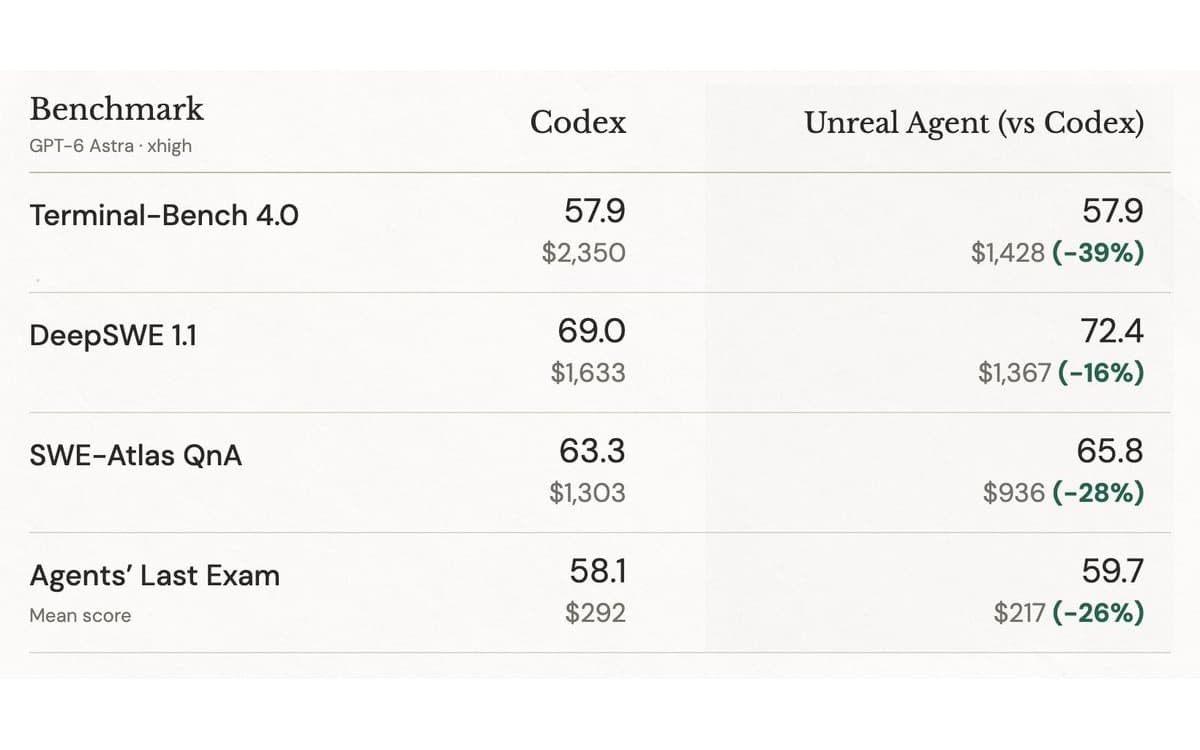
On Terminal-Bench 4.0, Unreal Agent scored a 57.9% pass rate. The Codex comparison result on the public leaderboard was also 57.9%, and the cost presented dropped from $2,350 to $1,428. That's about a 39.2% savings.
Separating tool calls from model turns
A typical agent can create turns in which the model calls a tool, waits until execution finishes, and then asks about the status again. When Unreal Agent receives a tool request, it records an "in progress" event in the session history and runs the actual work in the background. When the work finishes, it appends the result to the log and then calls the model again.
This way the model doesn't spend turns waiting on long tool jobs or repeatedly checking status. While environment setup is running, code exploration and web search can overlap, and the user can change direction or add new instructions even while tool work is in progress.
The structure explanation and a demo of it running that Unreal Labs published are available in its official X post.
Performance held, cost and model turns cut
Here is the cost and performance table Unreal Labs published. The Codex figures for comparison are public leaderboard results.
| Benchmark | Unreal Agent | Codex public leaderboard result | Cost savings |
|---|---|---|---|
| Terminal-Bench 4.0 | 57.9%, $1,428 | 57.9%, $2,350 | 39.2% |
| DeepSWE 1.1 | 72.4%, $1,367 26 turns · 1.60M input tokens | 69.0%, $1,633 30 turns · 2.19M input tokens | 16.4% |
| SWE-Atlas Codebase QnA | 65.8%, $936 16 turns · 898k input tokens | 63.3%, $1,303 22 turns · 1.69M input tokens | 28.2% |
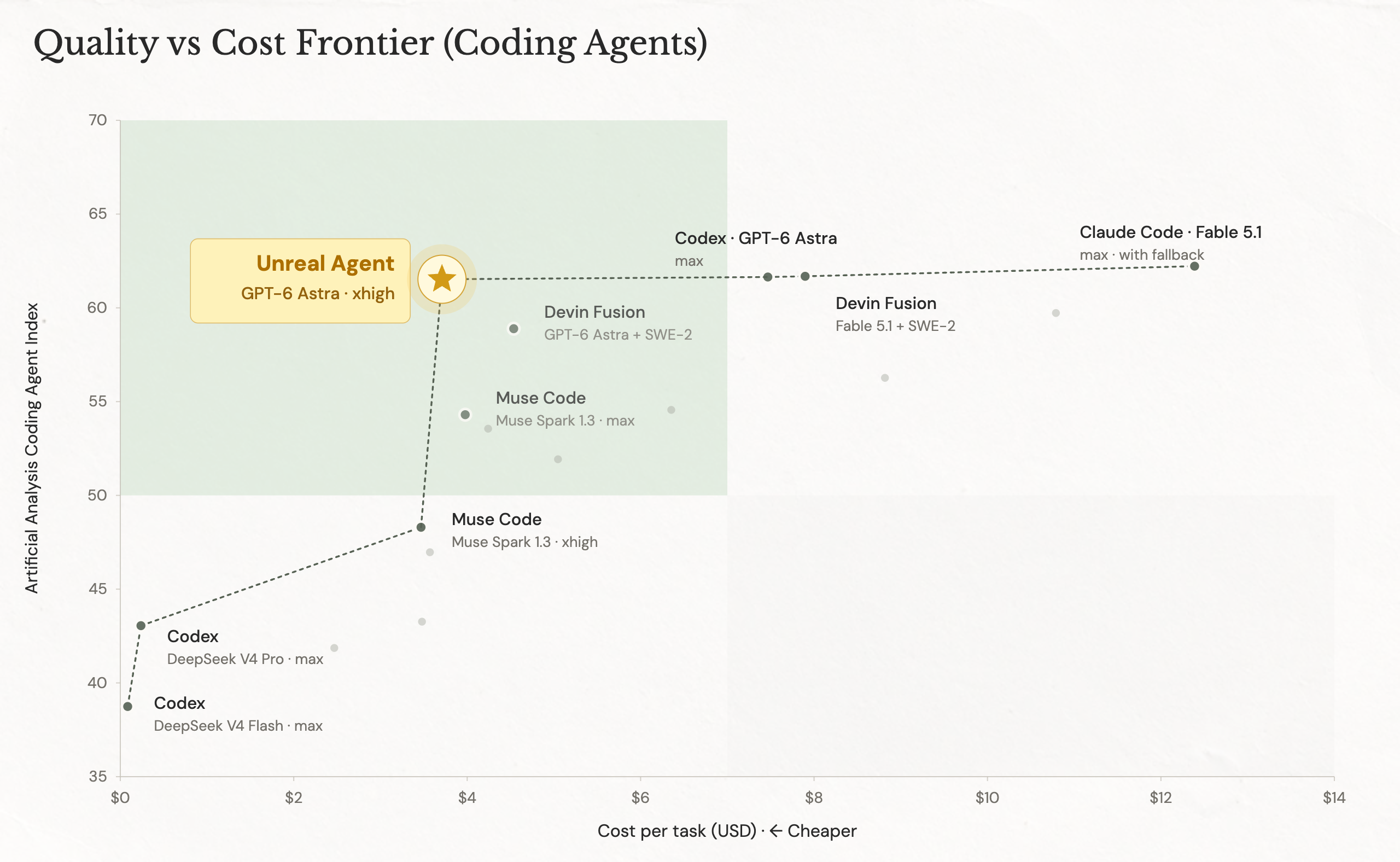
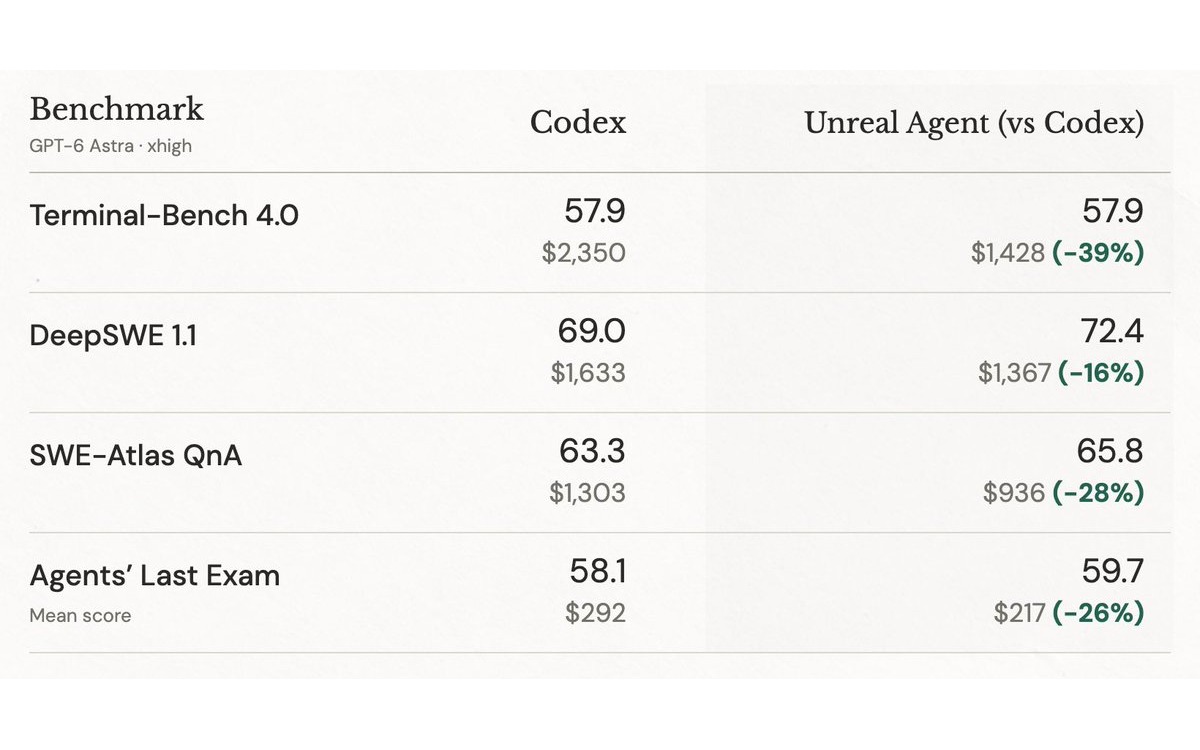
The cost savings rate is Unreal Agent's cost subtracted from Codex's cost, divided by Codex's cost. On Terminal-Bench it is 39.2%, which matches the announced "up to 40%." On DeepSWE the pass rate is 3.4 percentage points higher and the cost 16.4% lower. On SWE-Atlas the pass rate is 2.5 percentage points higher and the cost 28.2% lower.
The cost comparison and benchmark graphs are also included in a second official X post.
Built from concise tools and a simple flow
The public implementation is designed to keep prompts concise and pass along only the information the task needs from tool results. It overlaps multiple tool jobs asynchronously and, in a single-agent flow, takes in the user's new instructions and applies them to the next step.
In particular, the DeepSWE and SWE-Atlas tables publish model turns and input tokens alongside. When tool output is short and status-check calls decrease, you can see a path by which the input and model calls needed to finish the same task also drop.
Looking at the structure in an MIT-licensed repository
Unreal Agent is released under the MIT license in a GitHub repository. It includes a Go-based library and runner, plus a Harbor-compatible benchmark runner.
If you want to compare similar agent architectures, you can also read a case study of enterprise adoption of the OpenAI Codex harness. Along with model choice, harness design that connects tool calls is becoming an established research topic that shapes the cost of running agents.
Before dropping to a lower-tier model, count the turns your agent spends waiting or asking for status, and you can find where to cut costs.