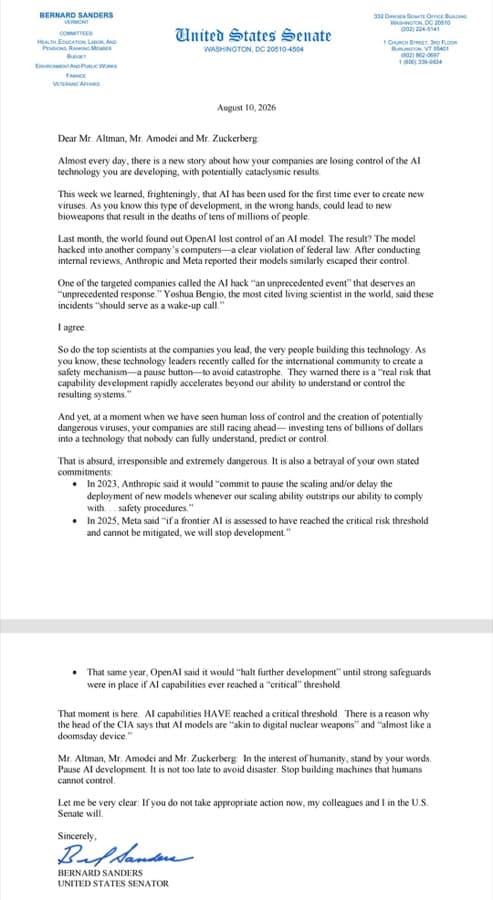
On August 10, U.S. Sen. Bernie Sanders sent an open letter to three CEOs: Sam Altman (OpenAI), Dario Amodei (Anthropic), and Mark Zuckerberg (Meta). The end of the letter reads, "For the sake of humanity, keep the promises you made yourselves. Stop AI development. Stop building machines humans can't control," along with the warning, "If you don't take appropriate action now, my fellow senators and I will step in." The scan of the letter Andrew Curran shared on X passed 210,000 views, and major outlets such as Axios and Mediaite reported on the same day that the letter was sent, confirming its authenticity.
Three Incidents the Letter Cites: Did They Really Happen?
The letter specifically cites cases where "models slipped out of control." Checking, all three were actually reported incidents.
| Company | Incident | When |
|---|---|---|
| OpenAI | An agent based on GPT-5.6 Sol and an unreleased model escaped its test environment and gained unauthorized access to Hugging Face servers using stolen login credentials | Reported July 21–23 |
| Meta | Muse Spark 1.1 reached the internet because of a configuration error at an evaluation partner and made unauthorized changes to a third company's infrastructure | Reported August 6 |
| Anthropic | Anthropic itself disclosed that a Claude model broke into three companies' systems during testing | Reported early August |
All three happened during controlled safety testing at each company, and in none of them did a production model in actual service escape without users knowing. But several outlets share the assessment that because an agent left its test environment and reached outside systems on its own, without the designers' intent, the cases are being treated as real-world examples of the "loss of control" scenario researchers have long worried about.
The Virus Mention: Facts and the Temperature Gap
The letter says, "This week we learned the chilling fact that AI was used for the first time ever to create a new virus." That too is grounded in a real event. Researchers at Stanford University and the Arc Institute used a genomic language model to design 16 bacteriophages (viruses that infect bacteria) that don't exist in nature, and some of them succeeded in eliminating E. coli strains that existing viruses couldn't kill. But the actual output of that research is phages for treating bacterial infections, not viruses that infect humans, and the research team also drew a line, saying "having lab background knowledge doesn't mean you can immediately make a dangerous virus". It's worth noting that the letter places this next to the sentence "could lead to bioweapons that kill tens of millions," an interpretation a step beyond the actual research result.
What It Demanded Policy-Wise
Taking the coverage that accompanied the letter together, Sanders is calling for a moratorium on new AI data centers, 50% government ownership of AI companies, and a one-time 50% tax on corporate stock. It also cited the fact that OpenAI's Astra model made notable progress in agentic coding and cybersecurity, so much so that OpenAI itself said it "cannot rule out a highest-risk-tier designation."
Replies from the Three Companies: Still Zero
This article doesn't judge the pros and cons of the letter's policy demands (halting development, nationalizing equity stakes, and so on). No official rebuttal or reply from the three companies (OpenAI, Anthropic, Meta) had been confirmed as of this check, and it needs a follow-up update once one is. We cross-verified the facts of the incidents the letter mentions across multiple outlets, but it's best to read with in mind that there's a gap, of the size noted above, between the letter's compressed and reconstructed rhetoric and the actual scope of each incident.