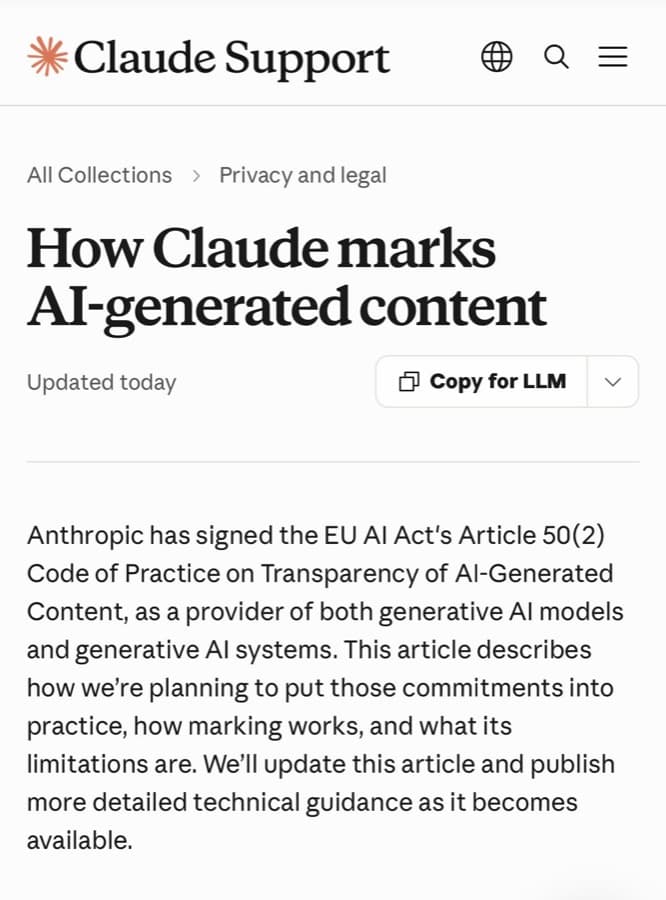
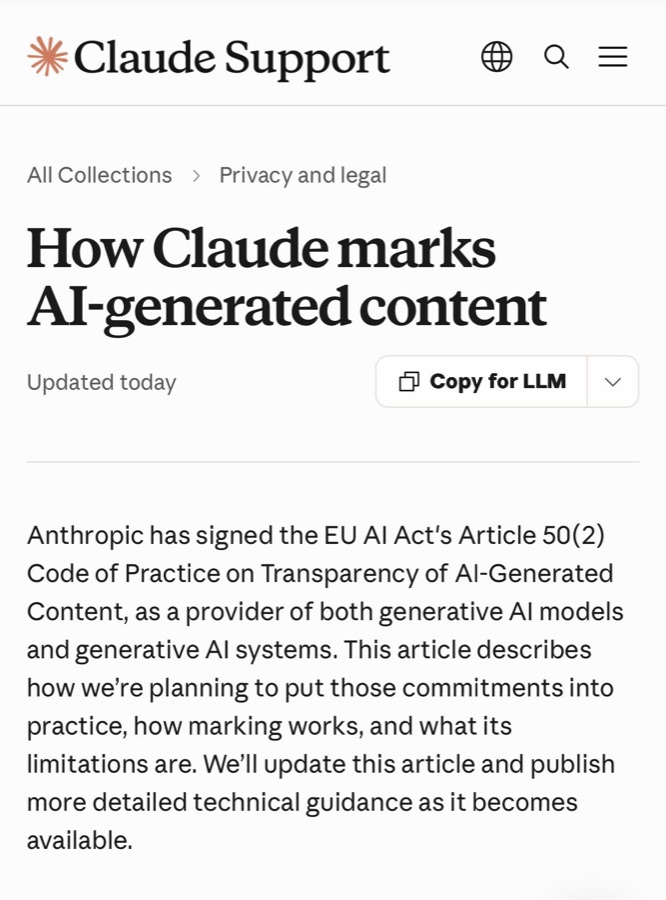
Starting August 2, 2026, all text Claude produces carries an invisible signature. There was no notice users could see, but through the official help center document "How Claude marks AI-generated content," Anthropic said it is embedding an invisible watermark in the text output of all Claude models worldwide. The one who first spread the news as breaking news wasn't Anthropic itself but the X account NIK (@ns123abc). His post saying "invisible watermarks are embedded in all text and all file metadata" drew 2.46 million views (original link), and Polymarket (@Polymarket) then posted similar news that collected 940,000 views (original link). It's worth stating clearly that neither account is an official Anthropic channel. Both are third-party accounts that re-spread the news.
Why Did a European Law Apply to Claude Users Worldwide?
This watermarking isn't a new feature introduced without warning. It's a measure carried out to coincide with a legal obligation taking effect. Anthropic had signed the Code of Practice related to Article 50(2) of the EU AI Act, and implementation began when this voluntary framework became legally binding on August 2, 2026. The notable point is that the measure isn't limited to European users. Instead of running the service differently by region, Anthropic decided to apply the same method to the output of all Claude models worldwide. interestingengineering.com covered it as a case of "regulation-driven global rollout," and cryptobriefing.com also reported that the EU AI Act taking effect and the watermarking rollout line up exactly.
A Fingerprint Left in Every Word Choice
Technically, the method statistically biases token (word) selection probabilities slightly as the text is generated, leaving a digital fingerprint that looks like natural sentences to the human eye but that detection tools can read. This fingerprint is reportedly preserved through copy and paste and light edits. Beyond text, files like SVG, PNG, and JPG also get signed C2PA metadata attached. What's interesting is the point that Claude isn't the first. Andrew Curran (@AndrewCurran_) noted that "Google has embedded a detectable statistical pattern in all text generated by Gemini since 2024, biasing tokens with a secret key," adding that it's unclear whether OpenAI is doing something similar (original link, 130,000 views).
| Company/model | When the invisible watermark applied | Public basis |
|---|---|---|
| Anthropic Claude | Fully applied worldwide as of 2026-08-02 | Official Claude help center document |
| Google Gemini | Said to be in place since 2024 | Andrew Curran's X post (third-party observation) |
| OpenAI | Unclear | No confirmed official material |
What Developers and Content Creators Should Check Now
The first practical thing to check: if text you handle was generated with Claude and circulated without any label, it's now in a state where it can be traced back with detection tools. For teams whose workflow is to draft blogs, marketing copy, or code comments with Claude and have humans polish before publishing, it's worth rechecking disclosure and labeling policies on the premise that the output can be identified as AI-generated. Conversely, if you need to verify the provenance of content, the possibility that a fingerprint remains in Claude-written text even after editing is useful information for plagiarism and copyright disputes or authenticity checks. But whether detection tools that can actually verify this watermark are available to everyone hasn't been clearly settled even among the sources.
Whether the Watermark Can Be Bypassed Is Undisclosed
Some questions remain unanswered at the technical-spec level. Whether the detection tool is public in a form third parties can verify, whether heavily rewriting the text or running it through translation bypasses the watermark, and whether different patterns are embedded per user account are things on which the sources have no unified explanation. Anthropic's official document and the coverage of it state clearly that watermarking exists and when it took effect, but it's accurate to leave further details as "needs confirmation." If you work with Claude, rather than changing your workflow right away, it's safer to watch whether Anthropic releases a detection tool or technical whitepaper and check follow-up information.