On the 9th, a short post from the X account How To Prompt (@HowToPrompt__) passed 100,000 views in a day. The post opens with "Harvard and MIT built an AI simulation of 8.3 billion virtual people — as many as the entire population of Earth," calls the project "MatrAIx," and describes it as "population-scale digital simulation infrastructure" driven by frontier models like GPT and Claude.
When a claim of this scale spreads on social media, it's usually an exaggeration or a mistranslation. But when we checked, this time it wasn't completely made up. A paper titled "MatrAIx: Simulating the World with 8.3 Billion Persona Agents" really exists, and the MIT Media Lab's "Large Population Models" project page also has related content. The official site is matraix.ai.
8.3 Billion Was "Data," Not "People"
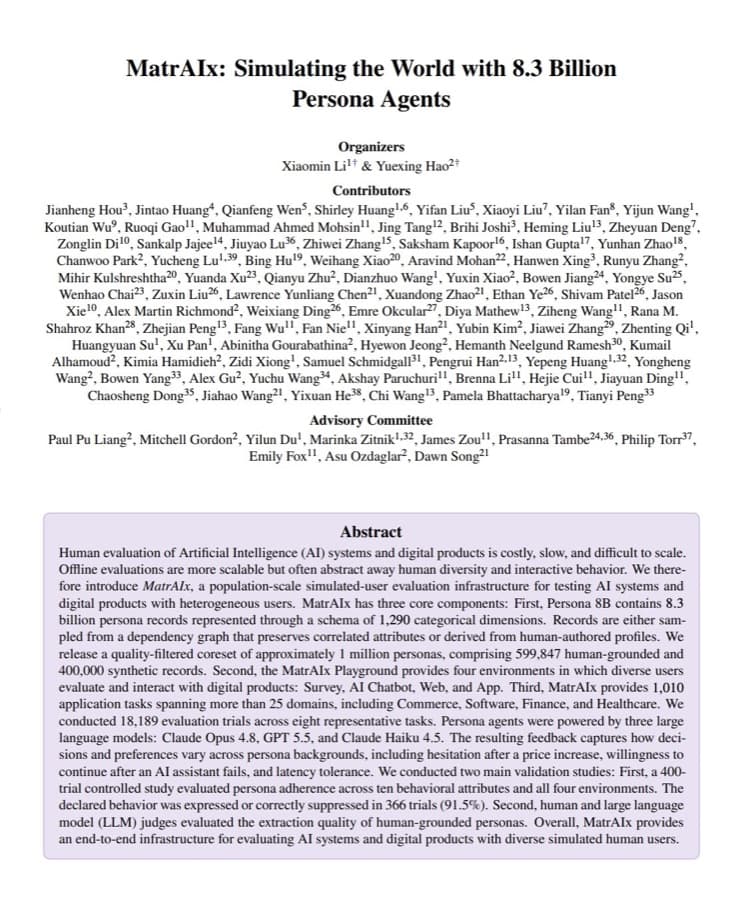
But the identity of the number differs from the tweet's impression. The core of the project is a dataset called "Persona 8B," 8.3 billion persona records expressed across 1,290 categorical dimensions. That is, it doesn't mean 8.3 billion living virtual personalities running at the same time. It means 8.3 billion combinations of demographic and behavioral traits exist in database form.
The more important point is the scale actually in use. The core set the researchers actually released after quality filtering is about 1 million people, of which 599,847 are based on real human data and the remaining 400,000 are synthetic. There's a gap of three orders of magnitude between the "8.3 billion people simulated" in the viral post and the scale actually running.
Not a "Simulation of Humanity," but "Product Pre-Testing Infrastructure"
What MatrAIx actually does is also far from sci-fi imagination. The "MatrAIx Playground" is a tool designed so persona agents use digital products and leave reactions in four environments: surveys, AI chatbots, the web, and apps. The research team ran 18,189 evaluation trials across 8 tasks, and these agents were driven by three models: Claude Opus 4.8, GPT 5.5, and Claude Haiku 4.5.
Seen this way, MatrAIx's reality isn't a "virtual Earth." It's closer to research pre-testing infrastructure that tries out survey, UX, and marketing message reactions on a large sample of synthetic personas before recruiting real users. Because you can quickly scan reactions across demographics without recruiting people when designing a new product survey or tuning chatbot replies, it's worth viewing as one example of market research automation using frontier models.
There are things that remain unconfirmed, though. How closely the 400,000 synthetic personas' biases resemble real human responses, and how accurately this core set can substitute for real market research and UX research results, haven't been verified yet. The phrase "simulated the whole planet" is closer to marketing copy, and the real academic achievement is building a large-scale persona dataset and an evaluation pipeline, and the two should be kept distinct.