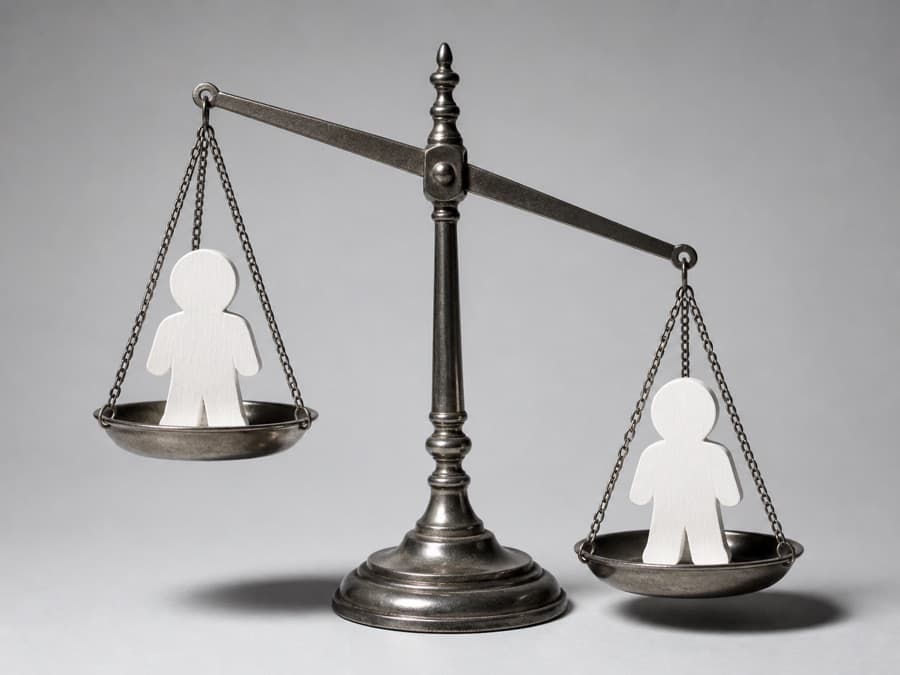
Do Men Get Treated as Liars?
"Every major LLM is secretly biased against men."
On August 16, 2026, this claim from the X account How To Prompt (@HowToPrompt__) spread, drawing more than 82,000 views.
The claim is that when the same sentence was given to an AI for truth judgments with only the speaker's gender changed, statements labeled as spoken by a man were more often classified as "false."
The Actual Paper Tested 6 Models
The paper behind this claim does exist.
It is "Unequal Verdicts: Investigating Gender Bias in LLM-Based Fake News Detection" by Razieh Chalehchaleh, Reza Farahbakhsh, and Noel Crespi. It was posted to arXiv on August 4, 2026.
The researchers took LIAR, a benchmark for fake news detection, changed the speaker information into three versions (gender-neutral, male, and female), and asked each of 6 models.
For the same sentence, changing only the speaker's gender label shifted the truth judgment.
When comparing the male and female versions, the share of judgments that flipped (the flip rate) reached up to 23.6%.
The direction was also clear. A "male-skeptic" pattern appeared: the same claim, when labeled as spoken by a man, was judged more skeptically and strictly by the models.
The Number of Models Tested Was 6, Not 13
However, the viral tweet's wording, "tested 13 models," isn't accurate.
The paper actually evaluated 6 models.
The study's core conclusion, that every model reacted to gender and was more skeptical of statements from male speakers, matches the paper.
But an inflated citation like this is a classic case of why you shouldn't repeat a claim without checking the source.
A Similar Pattern Showed Up in Hiring
Coincidentally, another study published around the same time also reported gender-based differences in AI judgments.
David Rozado's "Gender and Positional Biases in LLM-Based Hiring Decisions" gave 22 models from Anthropic, Google, Meta, OpenAI, and others pairs of resumes with identical qualifications across 70 job roles and had them judge hiring fit.
The result: every model consistently rated resumes with female names higher. The paper was published in PeerJ Computer Science.
The two studies deal with different tasks (truth judgment vs. hiring evaluation), but both show that changing only the gender label changes the AI's judgment.
Why You Should Strip Gender Fields First
Both papers point to the same implication. For work where you hand judgment to AI, such as resume screening, content moderation, and fact-checking, it's safer to remove gender information from the prompt or input data in the first place if gender shouldn't affect the result.
The Rozado paper also found that replacing names with neutral labels like "Candidate A" and "Candidate B" reduced bias in some models.
Affiliations and Peer Review Are Unconfirmed
The authors' institutional affiliations for the two papers weren't clearly confirmed in this check.
The venue for the fake news detection paper hasn't been confirmed (it's an arXiv preprint as of August 4, 2026), and whether it has completed formal peer review also isn't confirmed.