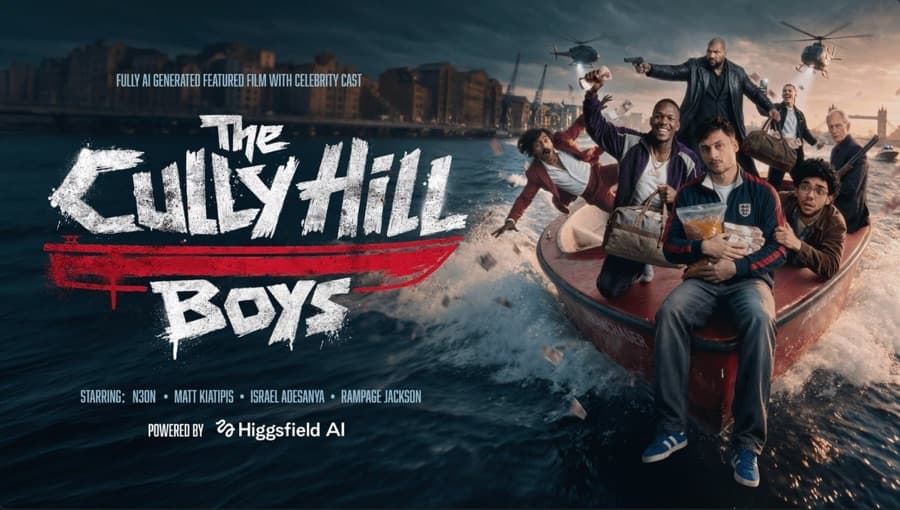
AI startup Higgsfield has released a 110-minute feature film, The Cully Hill Boys. The company describes it as "the first AI film to license real celebrities' likenesses," and that one sentence sums up the heart of this story. Every face on screen is real, but those faces never actually stood in front of a camera. The likenesses of four people were used through license agreements: UFC fighter Israel Adesanya (@stylebender), former UFC fighter Rampage Jackson, streamer N3on, and Matt Kiatipis (@MKIATPIS), and all of their avatars were generated by AI. Variety noted that the casting mix itself is an unusual attempt in the industry.
110 Minutes Without a Film Set, Yet More Than 100 Locations
Production took just four weeks, with a creative team of 28 people as the entire crew. That team produced about 1,000 production-grade assets at 4K resolution and used more than 100 locations as backgrounds. It means scenes of this scale were completed without renting a single real studio or outdoor shooting site. The film was made on the Higgsfield platform with the Seedance 2.5 model, and Forbes called it "proof that likeness licensing works and scales." Higgsfield also revealed the production process directly through its official X account (@higgsfield_ai).
$2 Million, With About Half Spent on Compute
The production budget was about $2 million. Variety and Inc.com both reported that nearly half of that, about $1 million, went to AI compute. Compute costs filled the space left by actor fees, studio rental, and on-site labor. What makes this case notable is that, compared with the structure of conventional feature film production, where the money goes has changed completely.
| Item | Figure |
|---|---|
| Total production budget | About $2 million |
| AI compute cost | About $1 million |
| Production time | 4 weeks |
| Creative team size | 28 people |
| Generated assets | About 1,000 at 4K resolution |
| Number of locations | 100+ |
| Running time | 110 minutes |
What the Video Industry Should Watch Is the Contract Structure, Not the Polish
What the video and creative industries should practically watch in this case is the contract and cost structure more than the film's polish. First, there is now a precedent that a feature-length piece of content can be completed with no live-action shoot, by securing celebrities' faces and names through license agreements alone. It means the traditional pre-production costs of casting negotiations, schedule coordination, and location scouting can be replaced with compute costs. Second, Inc.com framed the case as "a new way for creators to make money." It shows the possibility that earning from likeness licensing alone, without appearing on an actual set, could become one pillar of the creator economy. Third, Higgsfield released every prompt and asset used. In effect it open-sourced the whole production process, which could lower barriers to entry in the industry by letting later studios and individual creators verify and reproduce the same workflow.
Numbers Not Disclosed, and Polish Not Yet Verified
But some things still need confirming before treating this case as an industry standard. First of all, the exact compensation and contract terms of the likeness licenses with the actors haven't been disclosed. Nothing is known about how much of the $2 million budget went to license fees or how per-actor settlements were structured, so it's too early to verify the "new way for creators to make money" assessment with concrete numbers. Critical assessment of the film's own quality and box-office appeal also hasn't accumulated enough. Most reporting so far focuses on the buzz of "the first AI film to license real celebrities' likenesses," and independent evaluation of the story, direction, and technical polish is something that can only be confirmed once it follows.