

OpenAI unveiled the OpenAI Decisions API at DevDay on September 29 (local time, September 30 in Korea). It arrived about two weeks after TypeSafe Jev, with a decision API that works the same way. GPT-6 Luna picks one of the choices a developer defines in advance, and OpenAI says the response time is 0.15 seconds, about 10 times faster than a regular Luna call.
Source: X @OpenAIDevs
What the OpenAI Decisions API is: you set the question and the options, and GPT-6 Luna picks
A developer sets a question and a list of possible answers and sends text or images as context, and GPT-6 Luna returns one of them. OpenAI's example sends a customer inquiry together with a list of teams to route it to. The app takes the result and can assign the inquiry straight to the responsible team.
The official uses are content classification, request routing, and choosing an agent's next action. It is currently offered as a limited preview only to a select group of API customers chosen for testing, and OpenAI said it plans a broader launch within days. OpenAI DevDay recap
0.15 seconds, 10 times faster than a regular Luna call
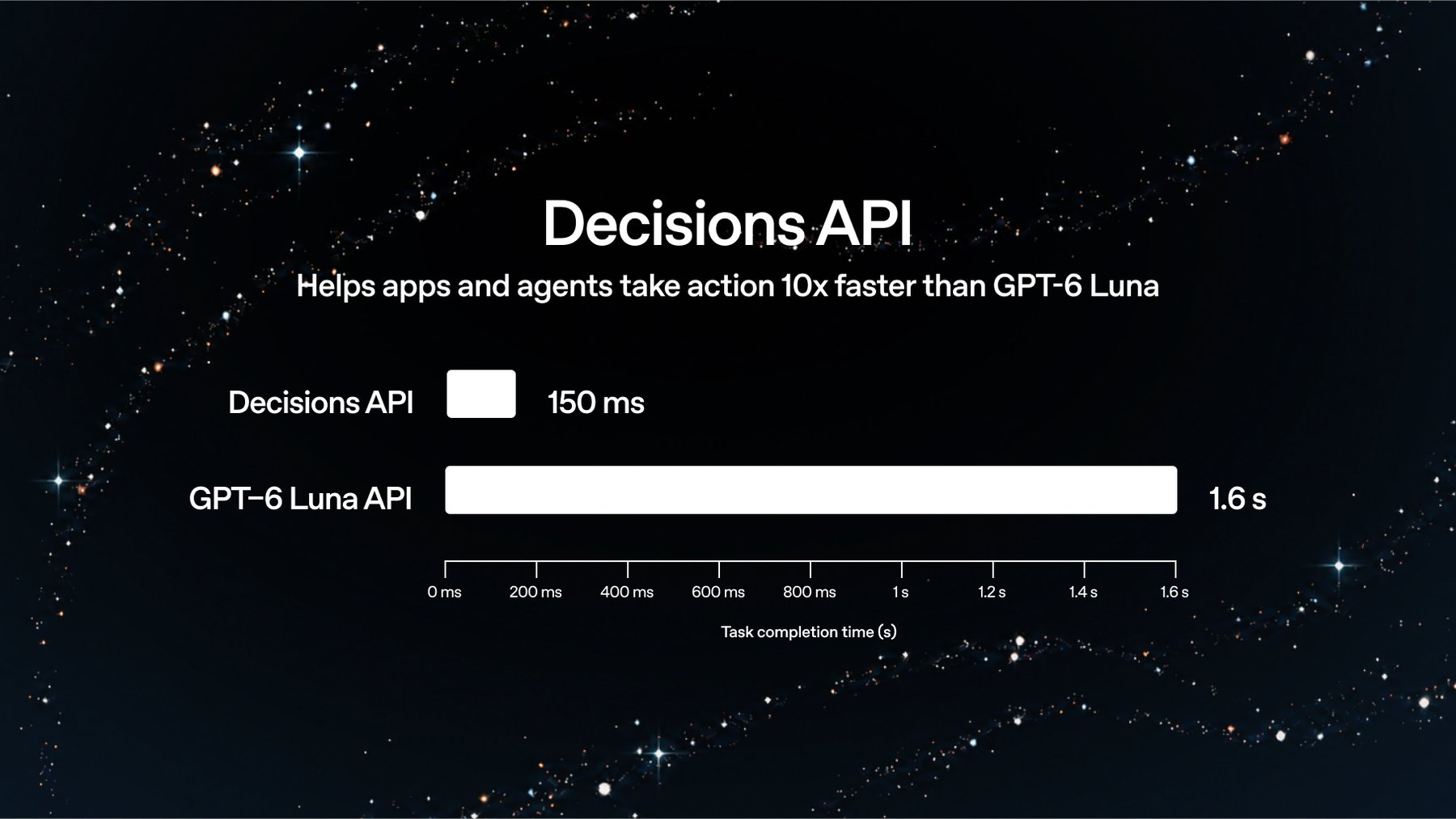
According to OpenAI's announcement slide, the Decisions API's task completion time is 150 milliseconds, while handling the same judgment with the regular GPT-6 Luna API takes 1.6 seconds. That is about a 10x difference. Because the model picks an answer from the allowed options instead of freely writing sentences, the output format is consistent, and you do not need to retrain a separate classifier every time you change the classification labels.
Pricing for the Decisions API itself has not been announced. The regular GPT-6 Luna API price is $0.10 per million input tokens and $0.50 per million output tokens. OpenAI API pricing
TypeSafe Jev, which brought this structure out first
TypeSafe was the first to ship this structure as a product. TypeSafe, led by Diogo Almeida, who worked on the InstructGPT research, released Jev on September 15 (local time, September 16 in Korea). Jev is a decision-only model that does not generate sentences but computes probabilities across several options.
In its launch announcement, TypeSafe said Jev is 20 to 200 times faster and 40 to 400 times cheaper than existing conversational models. The price is $0.042 per million input tokens, and output tokens are free. Because it gives a probability for every option, you can build a flow that handles high-probability judgments automatically and passes only ambiguous cases to a person.
Source: X @CompleteSkeptic
Source: X @CompleteSkeptic
In two weeks, the decision layer became a product category
Cua released a developer preview of jev-use for macOS, Windows, and Linux, which connects Jev as a decision layer to computer-operating agents. In a 2048 game run that Cua measured, a task on which Astra used 294.9 seconds and about $1.45 was finished by Jev in 44.9 seconds and about $0.00108. In that run it was about 5 times faster and about 1,000 times cheaper.
Source: X @trycua
On September 28, a reflex-router appeared for Claude Code, where Jev picks and applies the reasoning effort each task needs.
Source: X @ziyacivan
On the open-model side, Nimble appeared, which fine-tunes Qwen3.5-9B using Jev as the evaluator. Google's DiffusionGemma shows an approach that produces a probability distribution over options in one pass using diffusion.
Source: X @madiator
Source: X @googlegemma
I expected every LLM to get a Jev-style decision mode by default, but OpenAI responded faster than I thought.
Why it came out the same day as dots and the Agents API
On the same day, OpenAI also announced the always-on agent dots and computer-use capability in the Agents API. The Agents API offers the Codex harness's multi-agent coordination, tool search, and context compaction as a managed service and adds computer use. Official Agents API intro · Computer use docs
An agent that works 24 hours a day has to keep making small judgments, such as which email to answer and which task to open next. Handing every one to a large model is slow and costly. If you attach a model like Jev as the agent's decision layer, even the number of judgments possible in one task can change.
Model calls take the place of branching logic
Jev showed that a small team can open a new model category in two weeks, and OpenAI has entered that category with Luna, its smallest model. For developers already using the OpenAI API, there is now a way to attach a decision layer with one account.
TypeSafe will compete on published pricing, probability calibration, and accuracy. After the full launch, when Decisions API pricing and accuracy are published, you can compare the two approaches under real conditions. The lower the unit cost of an AI judgment inside software, the faster model calls are likely to take the place of branching logic that people used to write as rules.
Related posts
- CLM-8B, a decision model up to 9x faster than Jev: how it works and how to use it
- Run Unsloth Laya locally: An AI decision model on a 4GB RAM PC with a Jev-compatible API
- jevgrep: An open-source CLI that finds only the code your AI coding agent needs and cuts cost
Sources: OpenAI DevDay recap, OpenAI API pricing docs, TypeSafe, The Decoder