Everything really is becoming Jev. This time Perplexity has released the Decisions API and pplx-decider-v1-27b, a multimodal decision model. It is a fine-tune of Qwen3.8-27B that, instead of generating a long answer, outputs probabilities for a fixed set of options, so you can use it for tasks like sorting customer inquiries or routing agents. It costs $0.04 per million input tokens, output tokens are free, and the model weights are published on Hugging Face.
Perplexity's developer account announced the Decisions API at 03:24 KST on October 2, along with results on 11 benchmarks.
Source: X @perplexitydevs
pplx-decider-v1-27b: a decision model that outputs probabilities instead of prose
It reads text, JSON, and even images the way a language model does, but it doesn't write. It returns the likelihood of yes or no, probabilities for options you define, and probabilities for each level of a rubric. It doesn't write replies, write code, or explain its reasoning. Your own code makes the decision by comparing the returned numbers against thresholds. It fits the spots where you used to ask a chat model for a label and parse the answer: classification, routing, and rubric scoring. The context length is 250k tokens, and the license is Apache-2.0.
These are accuracy figures on a fixed 7,210-row panel from September 2026, and the pplx-decider results were measured through the Perplexity API.
| Benchmark | Jev | Qwen3.8-27B | pplx-decider-v1-27b |
|---|---|---|---|
| WinoGrande | 90.70% | 73.10% | 83.30% |
| FinancialPhraseBank | 76.98% | 75.68% | 84.18% |
| RAGTruth | 77.27% | 61.53% | 88.80% |
| JudgeBench | 78.57% | 68.86% | 78.29% |
| BBH | 94.27% | 72.80% | 82.80% |
| JevBench public hard | 73.27% | 72.28% | 70.30% |
| TabFact | 89.80% | 78.60% | 90.60% |
| ContractNLI | 77.45% | 80.78% | 80.78% |
| Circa | 84.60% | 87.00% | 89.20% |
| Belebele | 95.00% | 93.20% | 94.00% |
| TruthfulQA binary | 92.00% | 82.80% | 85.40% |
| Overall | 84.51% | 74.76% | 85.71% |
Overall accuracy is 85.71%, higher than Jev (84.51%) and the base model Qwen3.8-27B (74.76%), and it is the highest on RAGTruth, FinancialPhraseBank, TabFact, and Circa.
Three question types: noul, choice, and score
| Type | What it asks | What you get back |
|---|---|---|
noul | Yes or no | Probability of yes (0 to 1) |
choice | One of your own options (1 to 255) | Per-option probabilities, the top option, and confidence |
score | An ordered rubric (up to 10 levels) | Per-level probabilities and the expected score |
In a single request you can send 1 to 128 named questions about the same content (state) at once.
How to use the Decisions API
Any Perplexity API key issued at console.perplexity.ai works. Send JSON with Bearer authentication to POST https://api.perplexity.ai/v1/decisions.
curl -X POST https://api.perplexity.ai/v1/decisions \
  -H "Authorization: Bearer $PERPLEXITY_API_KEY" \
  -H "Content-Type: application/json" \
  -d '{
    "model": "pplx-decider-v1-27b",
    "state": {
      "title": "Battery died after two weeks",
      "review": "The headphones sound great, but the battery stopped charging after two weeks."
    },
    "questions": {
      "defect": {
        "type": "noul",
        "instructions": "Does the review report a product defect?"
      },
      "sentiment": {
        "type": "choice",
        "instructions": "What is the overall sentiment of the review?",
        "criteria": {
          "positive": "Mostly satisfied",
          "mixed": "Praise and complaints in one review",
          "negative": "Mostly dissatisfied"
        }
      },
      "severity": {
        "type": "score",
        "instructions": "How severe is the reported problem?",
        "criteria": ["Cosmetic", "Inconvenient", "Product unusable"]
      }
    }
  }'
defect has a 94% probability of being a defect report. In sentiment, mixed is highest at 95%. The 1.78 for severity sits between Inconvenient (1) and Product unusable (2), closer to 2. confidence is different from the top probability; it drops the closer the second-place option is.
Put images in the state array and send them as PNG, JPEG, or WebP base64 data URLs. HTTP image URLs return a 400 error. Each image is allowed up to 2,048 tiles of 32×32 pixels, so 1440×1440 and 2048×1024 work but 1600×1310 goes over. If you exceed the limit, you may get a 504 after about a minute. Images cost roughly 1,000 input tokens per megapixel.
| Item | Limit |
|---|---|
| Questions | 1 to 128 per request |
| Choice options | 1 to 255 |
| Score levels | 1 to 10 |
| Input | Under 262,144 tokens |
| Request body | 32 MiB |
| Rate | 10 calls per second per organization |
In September 30 measurements, requests of a few hundred tokens took under 2 seconds, about 90,000 tokens took 5 seconds, about 190,000 tokens took 14 seconds, and a request right at the limit took 23 seconds. A 30-second client timeout is enough.
Where to use it: from support-ticket triage to agent routing
The official ticket triage cookbook classifies 12 tickets with three questions each and hands off to the Agent API only when a ticket needs escalation. Perplexity uses a model-based classifier to monitor reinforcement learning (RL) rollouts, which speeds up training and helps fix problems in RL environments and model behavior.
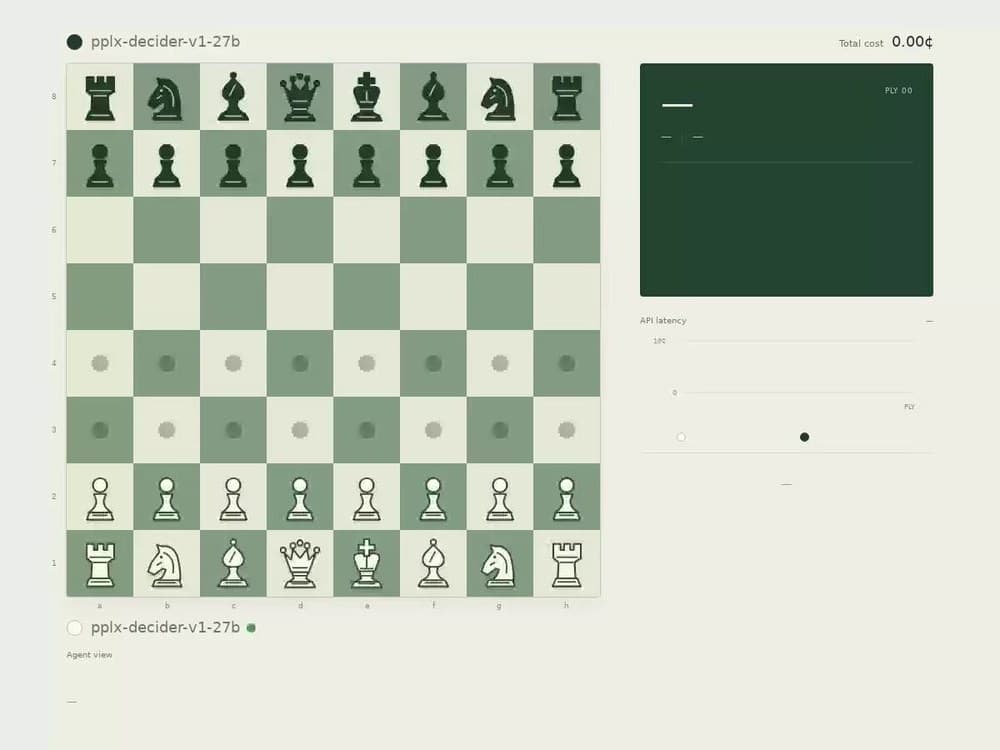
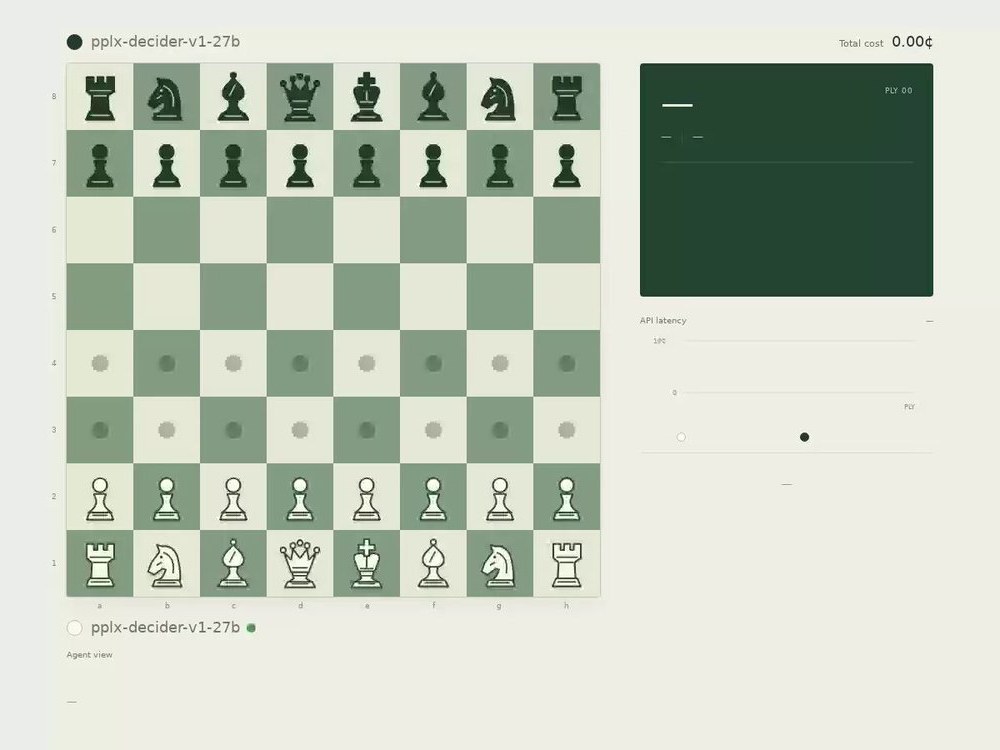
Co-founder Denis Yarats posted a live video demo of the model playing both sides of a chess game from nothing but a screenshot of the board. Each move is chosen through the API in about 140 ms.
Source: X @denisyarats
Pricing and running it locally
Input costs $0.04 per million tokens, output tokens are free, and there is no per-request fee. You can calculate cost from usage.input_tokens in the response, and it is billed to the organization that owns the API key.
CEO Aravind Srinivas said Perplexity will lower the price further within a few days (October 2, 06:37 KST).
Source: X @AravSrinivas
You can download the weights from Hugging Face. You need Python 3.12 or later and a CUDA GPU that can hold about 49 GiB of weights plus working memory.
uvx --from huggingface-hub hf download perplexity-ai/pplx-decider-v1-27b inference.py --local-dir .
uv run inference.py
from inference import Decider
model = Decider.from_pretrained("perplexity-ai/pplx-decider-v1-27b")
result = model.predict(
"My Stripe integration keeps failing. Please help ASAP.",
{
"type": "choice",
"instructions": "Which team should handle this request?",
"criteria": {
"billing": "Charges and refunds",
"technical_support": "Integration errors",
"sales": "Questions about buying a product",
},
},
)
print(result) # Selected choice and calibrated probabilities.A noul question can be sent like {"type": "noul", "instructions": "Does this message express urgency?"}, and for images use images=["screenshot.png"] or uv run inference.py --image screenshot.png.
A market that appeared within weeks of Jev
TypeSafe Jev was released at 04:33 KST on September 16. A wave of decision models built around options and probabilities followed quickly.
Source: X @typesafeai
OpenAI announced a Decisions API based on GPT-6 Luna at 03:34 on September 30.
Source: X @OpenAIDevs
Liquid AI released its first decision model, d1, at 03:35 on September 30.
Source: X @liquidai
Ollama said at 13:25 on September 30 that it supports local decision models, which you can start with
ollama pull nimble.Source: X @ollama
Inception Labs announced Mercury Decide at 04:12 on October 1 and connected it to OpenRouter as
inception/mercury-decide.Source: X @_inception_ai
At 03:24 on October 2, Perplexity released
pplx-decider-v1-27band opened the weights as well.
A new AI architecture is turning into a market within a few weeks.
Related reading
- OpenAI Decisions API Launches: Two Weeks After Jev, GPT-6 Luna Picks an Option in 0.15 Seconds
- Liquid AI d1: Liquid AI's First Decision Model, the First to Beat Jev, and How to Use the API
- Running Unsloth Laya Locally: A Jev-Compatible API for an AI Decision Model on a PC With 4 GB of RAM